| Roopak Goswami |

Limenitis rileyi. Picture courtesy: British Natural History Museum, London
Guwahati, Jan. 31: A butterfly, spotted in Arunachal Pradesh nearly three decades back, has been finally described as a new species.
The Limenitis rileyi Tytler was sighted by London-based naturalist Purnendu Roy in Upper Dibang Valley district in 1987, and has now been reported in the current issue of Journal of Threatened Taxa. "This sighting of L. rileyi represents the first record of this species from India, thus adding to India's butterfly fauna," the article says.
The species was previously recorded in southeast Tibet, Myanmar and northern Vietnam.
Roy had found a single male specimen on July 19, 1987, at a height of around 1,800 metres near Anini in Upper Dibang Valley in a wet sub-tropical broad-leaf forest.
A neighbouring subspecies, L. rileyi xizangana Huang, was recorded in southeast Tibet in 1998. The Dibang Valley record lies between southeast Tibet and northeast Myanmar records and fills a gap in the distribution. No subspecies determination has been made because of the sample size of one. Records of L. rileyi from southeast Tibet and northeast Myanmar indicate a flight period of June to August at altitudes between 1,600m and 2,400m.
"When I collected the butterfly back in 1987 in Upper Dibang Valley, there was no freely available literature to identify this species. Even now it is not illustrated on the Internet to my knowledge. H.C. Tytler unfortunately did not illustrate the species when he described it in 1940 from northeast Myanmar. At the time it was bit of a dead end for investigation so I had left it tentatively identified to a related species L. mimica that occurs in Myanmar and China.
"In 2012, my partner Jo persuaded me that I should spend more time on butterflies again. After hearing about the work of Sanjay Sondhi of Titli Trust, I contacted him and offered to assist in the surveying of moths and butterflies at Pakke tiger reserve and Eaglenest wildlife sanctuary. It was after that trip that I decided to approach the British Natural History Museum, London, to assist in identifying what I could not identify in 1987. David Lees identified the species as L. rileyi. He also recognised that another specimen I had was not described before, which I named Callerebia dibangensis in 2003," Roy told The Telegraph.
He said the butterfly is found in wet sub-tropical Montane forests at around 1,800m. Such areas can be inaccessible in monsoon owing to landslides and with frequent rains it can be a lottery to observe butterflies. Consequently, species that fly in monsoon like this species, maybe overlooked, he added.
Roy said habitat loss is the greatest risk to any species. Where the species was collected, the forest is quite fragmented and so locally could be at risk. There are larger forests where it may be less at risk but these are quite inaccessible or in protected areas. "I think it is essential that local biodiversity is conserved and that we are not just left with islands of biodiversity, inaccessible to most people and more vulnerable. For the lower forests, the proposed Dibang Valley dam is a major threat. Despite being initially rejected by the forest advisory committee in 2013, it has been given the go ahead again and some of India's finest forests will be destroyed," he said.
|
Showing posts with label New Species. Show all posts
Showing posts with label New Species. Show all posts
Wednesday, February 1, 2017
New butterfly, spotted three decades back

Thursday, November 21, 2013
A new species of spiders discovered in Satara
In 2010, when two researchers were busy observing migratory birds at a dam near Satara, Maharashtra, they spotted a distinct spider with a red stripe on its back. However, they just took a picture of it and left. "When we later researched this particular spider, we found out that it was called the Red-back spider. It had its origin in Australia but they were few records of it in India. We reported its existence in Satara district and this gradually got us interested in spiders," says Sidharth Kulkarni, who, along with his colleague Dr V Y Deshpande, spends much of his time at the zoology department of the Yashwantrao Chavan Institute of Satara (YCIS) studying spiders.

The two have now discovered a new species that belongs to the family of lynx spiders scientifically known as Oxyopidae. They have decided to name it Oxyopes Sataricus, after the Satara region.
The scientists, who are studying spider diversity in western Maharashtra, have worked together on chronicling the life stages of the Red-back spider Latrodectus hasselti, recording the scorpion-tailed spider for the first time in Maharashtra and some lynx spiders for the first time in India. "We are also hoping to study spiders as agents for controlling pests," says Deshpande. "Various spiders feed upon specific pests. Hence this research could bring out a natural and cost-free solution and possibly an alternative to chemical pesticides," says Kulkarni.
Spiders belong to the class Arachnida and not Insecta. "The basic differentiation between these two classes is that the cephalic (head) and thoracic (thorax) region is fused in class Arachnida and called cephalothorax. Insects usually have antennae and three pairs of legs while in spiders, antennae are absent and they have four pairs of legs," says Kulkarni, adding that the ecological importance of the spiders is distinct from that of insects.
Ref:

Image form Animal Discoveries 2012, ZSI
The two have now discovered a new species that belongs to the family of lynx spiders scientifically known as Oxyopidae. They have decided to name it Oxyopes Sataricus, after the Satara region.
The scientists, who are studying spider diversity in western Maharashtra, have worked together on chronicling the life stages of the Red-back spider Latrodectus hasselti, recording the scorpion-tailed spider for the first time in Maharashtra and some lynx spiders for the first time in India. "We are also hoping to study spiders as agents for controlling pests," says Deshpande. "Various spiders feed upon specific pests. Hence this research could bring out a natural and cost-free solution and possibly an alternative to chemical pesticides," says Kulkarni.
Spiders belong to the class Arachnida and not Insecta. "The basic differentiation between these two classes is that the cephalic (head) and thoracic (thorax) region is fused in class Arachnida and called cephalothorax. Insects usually have antennae and three pairs of legs while in spiders, antennae are absent and they have four pairs of legs," says Kulkarni, adding that the ecological importance of the spiders is distinct from that of insects.
Ref:
Wednesday, September 18, 2013
New Species of Legless Lizard Found at LAX

What’s more, the same team discovered three additional new species of these distinctive, snake-like lizards that are also living in some inhospitable-sounding places for wildlife: at a vacant lot in downtown Bakersfield, among oil derricks in the lower San Joaquin Valley and on the margins of the Mojave desert.
All are described in the latest issue of Breviora, a publication of the Museum of Comparative Zoology at Harvard University.
“This shows that there is a lot of undocumented biodiversity within California,” Theodore Papenfuss, one of the scientists, was quoted as saying in a press release.
Papenfuss, an amphibian and reptile expert at Berkeley’s Museum of Vertebrate Zoology, made the discoveries with James Parham of California State University, Fullerton.
“These are animals that have existed in the San Joaquin Valley, separate from any other species, for millions of years, completely unknown,” Parham said.
Legless lizards look a lot like snakes, but they’re different reptiles. The lizards are distinguishable from their slithery relatives based on one or more of the following: eyelids, external ear openings, lack of broad belly scales and/or a very long tail. Snakes, conversely, have a long body and a short tail.
Legless lizards, represented by more than 200 species worldwide, are well adapted to life in loose soil, Papenfuss said. Millions of years ago, lizards on five continents independently lost their limbs in order to burrow more quickly into sand or soil, wriggling like snakes. Some still have vestigial legs.
Though up to 8 inches in length, the creatures are seldom seen because they live mostly underground, eating insects and larvae, and may spend their lives within an area the size of a dining table. Most are discovered in moist areas when people overturn logs or rocks. It’s interesting to consider the LAX-based lizard’s life, considering all of that airplane rumbling overhead!
The researchers are now working with the California Department of Fish and Wildlife (CDFW) to determine whether the lizards need protected status. Currently, the common legless lizard is listed by the state as a species of special concern.
“These species definitely warrant attention, but we need to do a lot more surveys in California before we can know whether they need higher listing,” Parham said.
Papenfuss noted that two of the species are within the range of the blunt-nosed leopard lizard, which is listed as an endangered species by both the federal and state governments.
“On one hand, there are fewer legless lizards than leopard lizards, so maybe these two new species should be given special protection,” he said. “On the other hand, there may be ways to protect their habitat without establishing legal status. They didn’t need a lot of habitat, so as long as they have some protected sites, they are probably OK.”
Image: Theodore Papenfuss and James Parham/UC Berkeley
Original Story
Friday, September 10, 2010
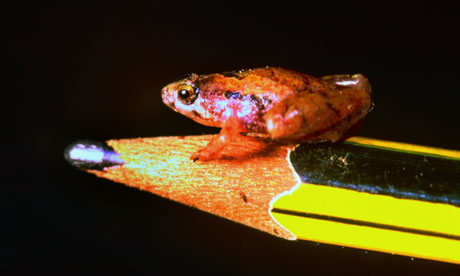
Pea sized frog found on Borneo island
KUALA LUMPUR (Reuters) - Scientists have discovered a frog the size of a pea, the smallest found in Asia, Africa or Europe, on the Southeast Asian island of Borneo.
 The frog species Microhyla nepenthicola, discovered in Borneo. Photograph: Indraneil Das/AFP/Getty Images
Adult males of the new micro-species range in size from 10.6 and 12.8 millimetres and the pea-sized amphibian has been named Microhyla nepenthicola after the plant on Borneo on which it lives, according to taxonomy magazine Zootaxa.
Dr Indraneil Das of the Institute of Biodiversity and Environmental Conservation at the Universiti Malaysia Sarawak said the sub-species had originally been mis-identified in museums.
 The Microhyla nepenthicola. Photograph: Indraneil Das/AFP/Getty Images
"Scientists presumably thought they were juveniles of other species, but it turns out they are adults of this newly-discovered micro species," he said.
Das published the paper with Alexander Haas of the Biozentrum Grindel und Zoologisches Museum of Hamburg, Germany.
The mini frogs were found on the edge of a road leading to the summit of the Gunung Serapi mountain in the Kubah National Park in the Malaysian state of Sarawak.
The scientists said they tracked the frogs by their call, a series of "harsh rasping notes" that started at sundown.
They then made the frogs jump onto a piece of white cloth to study them.
The find was part of a global search being undertaken by Conservation International and International Union for Conservation of Nature's Amphibian Specialist Group to "rediscover" 100 species of lost amphibians (www.conservation.org/lostfrogs).
(Reporting by David Chance; Editing by Sanjeev Miglani)
© Thomson Reuters 2010 All rights reserved
Link to news on Reuters
 The frog species Microhyla nepenthicola, discovered in Borneo. Photograph: Indraneil Das/AFP/Getty Images
Adult males of the new micro-species range in size from 10.6 and 12.8 millimetres and the pea-sized amphibian has been named Microhyla nepenthicola after the plant on Borneo on which it lives, according to taxonomy magazine Zootaxa.
Dr Indraneil Das of the Institute of Biodiversity and Environmental Conservation at the Universiti Malaysia Sarawak said the sub-species had originally been mis-identified in museums.
 The Microhyla nepenthicola. Photograph: Indraneil Das/AFP/Getty Images
"Scientists presumably thought they were juveniles of other species, but it turns out they are adults of this newly-discovered micro species," he said.
Das published the paper with Alexander Haas of the Biozentrum Grindel und Zoologisches Museum of Hamburg, Germany.
The mini frogs were found on the edge of a road leading to the summit of the Gunung Serapi mountain in the Kubah National Park in the Malaysian state of Sarawak.
The scientists said they tracked the frogs by their call, a series of "harsh rasping notes" that started at sundown.
They then made the frogs jump onto a piece of white cloth to study them.
The find was part of a global search being undertaken by Conservation International and International Union for Conservation of Nature's Amphibian Specialist Group to "rediscover" 100 species of lost amphibians (www.conservation.org/lostfrogs).
(Reporting by David Chance; Editing by Sanjeev Miglani)
© Thomson Reuters 2010 All rights reserved
Link to news on Reuters
Wednesday, April 28, 2010
New British moth found in Hembury Woods is world first
By Matt Walker
Editor, Earth News
Editor, Earth News


The type specimen
A moth new to science and found nowhere else in the world has been formally recognised as living in the UK.
The 3mm-long micro moth, which lives in Hembury Woods in Devon, was recognised as a new species this year. This week, the biologist who discovered it is presenting the Natural History Museum of London with one of the first known specimens.
The receipt of this "type" specimen will mark the official acceptance of the moth's existence in the country.
The tiny micro moth, which has a wingspan of just 6mm, was first spotted in 2004.
 Hembury Woods: home to the moth |
In January this year, the moth was officially recognised in the journal Zookeys as a new species, named Ectoedemia heckfordi after its discoverer.
It is not known to live outside of the UK.
Official presentation
Now Mr Heckford is presenting the Natural History Museum with the original specimen.
That is important, because it marks the official acknowledgement by the scientific world of the specimen as the "type" for that species, against which any future finds will be compared and determined.
 |
"Amateur naturalists have a wonderful window on the wildlife world and nature continues to amaze us and throw up surprises even in the UK."
There are well over 2,000 species of micro moth in the UK.
They come in various shapes and sizes, but many are extremely pretty, though only appreciated under magnification.
A few are actually larger than some larger, so-called macro moths.
 Dark mines made by the caterpillar of the species |
Most are plant feeders, with larvae often mining galleries in leaves, between the leaf surfaces.
A few mine stems.
Some, though, breed in fungi and a few have aquatic larvae.
Most are nocturnal but quite a few also fly by day.
Caterpillars of the new species are found mostly on oak saplings and low growth of oak in the shade.
The mines they make are quite dark and the caterpillars are bright green which is quite unusual for micro moths.
The adults lay their eggs on the underside of the leaf.
Story

Moths (Fauna of India ; Moths)

Life-histories of Indian insects: Microlepidoptera (Memoirs of the Department of Agriculture in India : Entomological series)

The Fauna Of British India Including Ceylon And Burma..Moths...Three Volume Set..1892,1894, and 1895

The silkworm moths of India;: Or, Indian Saturnidae: a family of bombycia moths, with antennae of males distichously pectinate and body wooly. Six plates, ... work on the silkworm moths of India

Tuesday, September 29, 2009
19 new species of flora and fauna in Sikkim
GANGTOK: Sikkim continues to maintain its pole position as the country's richest state in terms of bio-diversity with the World Wildlife Foundation (WWF) saying that 19 new species of flora and fauna has been found in the state in the last 10 years.
Of the 353 species of flora and fauna discovered in the eastern Himalayan range between 1998 and 2008, Sikkim has generated 19 species comprising plants and fish, the WWF said in its report.
The WWF surveyers also discovered 21 new species of orchids in the range of which five have been found in Sikkim, the report said.
The new variety orchid - coelogune pantlingii (pure white) - has been found in several parts of Sikkim, it said adding of 14 fish varieties found Sikkim has contributed three varieties - Pseudopoda abnormis, Pseudopoda hingstoni and Pseudopoda minor.
Meanwhile, the Japanese International Cooperation Agency (JICA), carrying out a survey work in Sikkim for the proposed integrated forest development programme to be funded by the agency, has complimented the state for being a reserve of a number of flora and fauna which are not found in other parts of the world.
Story
Of the 353 species of flora and fauna discovered in the eastern Himalayan range between 1998 and 2008, Sikkim has generated 19 species comprising plants and fish, the WWF said in its report.
The WWF surveyers also discovered 21 new species of orchids in the range of which five have been found in Sikkim, the report said.
The new variety orchid - coelogune pantlingii (pure white) - has been found in several parts of Sikkim, it said adding of 14 fish varieties found Sikkim has contributed three varieties - Pseudopoda abnormis, Pseudopoda hingstoni and Pseudopoda minor.
Meanwhile, the Japanese International Cooperation Agency (JICA), carrying out a survey work in Sikkim for the proposed integrated forest development programme to be funded by the agency, has complimented the state for being a reserve of a number of flora and fauna which are not found in other parts of the world.
Story
163 new species found – let’s not lose them now!
25 September 2009
A new WWF report celebrates the recent discovery of 163 new species in the Greater Mekong region of South-east Asia – including a bird-eating fanged frog, a leopard-patterned gecko and a bird that would rather walk than fly – but we also warn they could soon face extinction because of climate change.
 Our report, entitled Close Encounters, lists 100 new plants, 28 fish, 18 reptiles, 14 amphibians, 2 mammals and a bird, all identified in the last year by scientists within the jungles and rivers of the Greater Mekong, which spans Cambodia, Laos, Myanmar, Thailand, Vietnam and the south-western Chinese province of Yunnan.
The discoveries include: a bird-eating fanged frog that lies in streams waiting for prey; a bird called the Nonggang babbler, which walks longer distances than it flies, only taking flight when frightened; and the leopard gecko, a reptile with orange eyes, spindly limbs and technicolour skin.
But recent studies show the climate of the Greater Mekong region is changing, and models suggest continued warming, increased variability and more frequent and damaging extreme climate events.
Rising seas and saltwater intrusion will cause major coastal impacts, especially in the Mekong River delta, one of the three most vulnerable deltas on Earth, according to the most recent International Panel on Climate Change report.
WWF’s Heather Sohl says: “It’s great news that science is uncovering exciting and unusual new species like these, but it’s very worrying that no sooner do we find a new species than we have to sound an alarm over its prospects for survival.
“Rare, endangered and endemic species like these will be especially vulnerable to climate change, which has the potential to reduce their already restricted habitats.
“WWF is already working with governments and industries in the six Greater Mekong nations to conserve and sustainably manage 600,000 km2 of trans boundary forest and freshwater habitats in this unique and rapidly changing land. But we also need global action.
“With UN climate talks beginning in Bangkok this week, we’re urging world leaders to sign a strong global climate deal to prevent runaway climate change and to help safeguard regions like the Greater Mekong.”
Story
Tuesday, August 11, 2009
More than 350 new species discovered in Himalayas
More than 350 new species of animals, fish and plants have been discovered in one of the world's "most biologically rich areas" over the last decade, conservationists said today.

Among the discoveries are a bright green frog (Rhacophorus suffry) which uses its red and long webbed feet to glide in the air Photo: WWF
But the Eastern Himalayas, a region spanning Bhutan, Nepal, Tibet, north eastern India and the far north of Burma, is also one of the areas most under threat from climate change, a report by WWF warns.
It is feared the impacts of a warming climate, such as melting glaciers and flooding, will exacerbate existing environmental threats including logging, overgrazing, the wildlife trade and pollution.
Already only a quarter of the region's original habitat, which includes the lowland home of Asian elephants, clouded leopards, cobras and geckos and the high northern region where snow leopards, red pandas and blue sheep are found, remains.
The region harbours 10,000 plant species, 300 mammals, 977 bird species, 176 reptiles and 269 types of freshwater fish, has the highest density of the Bengal tiger and is the last bastion of the greater one-horned rhino, WWF said.
But some 163 species are globally threatened with extinction, the Eastern Himalayas – Where Worlds Collide report warns, with 14 of them critically endangered.
In the last 10 years, 244 new plants, 16 amphibians, 16 reptiles, 14 fish, two birds and two mammals – a macaque monkey and a miniature muntjac, the oldest and smallest species of deer – have been discovered.
When scientists first spotted the "leaf deer", they thought it was a juvenile of another species but DNA tests confirmed it was a distinct and new species.
The discoveries of 353 new species, which also included a bright green frog, which uses its red webbed feet to "fly" through the air and species of orchids, poppies and bamboo, puts the area on a par with Borneo as a hot spot for new wildlife.
The Eastern Himalayas are also the site of the discovery of the oldest fossil gecko species known to science, the 100 million-year-old gecko, found in an amber mine in the far north of Burma.
Mark Wright, WWF's conservation science adviser, said: "These exciting finds reinforce just how little we know about the world around us.
"In the Eastern Himalayas we have a region of extraordinary beauty and with some of the most biologically rich areas on the planet.
"Ironically, it is also one of the regions most at risk from climate change, as evidenced by the rapid retreat of the glaciers, and only time will tell how well species will be able to adapt – if at all."
The WWF report calls for a number of measures to protect the environment of the Eastern Himalayas, and the people that live in and depend on the region for their food, fresh water and livelihoods.
The study urges Bhutan, India and Nepal to work together for a region-wide vision for conservation and sustainable development and to tackle wildlife crime.
It also calls for efforts to support communities to cope with the impacts of climate change and says development such as hydropower schemes and tourism ventures must take the environment into account.
The conservation charity is also calling for governments meeting in Copenhagen in December for talks on a new climate change global deal to commit to a reduction in emissions of 40% by developed nations by 2020, compared to 1990 levels.
Mr Wright said: "There is no room for compromise on this issue; without these cuts the Himalayas face a precarious future – impacting both the unique wildlife and the 20% of humanity who rely on the river systems that arise in these mountains."
Subscribe to:
Posts (Atom)