Showing posts with label Vijay Barve. Show all posts

Sunday, March 4, 2018

Biodiversity Meet, Nagaland 2018


Butterflies & moths, birds, odonates, spiders, amphibians & reptiles, cicadas and more…

Sukhai, Ghukhuyi & Kivikhu, Zunheboto District, Nagaland

Dates: 9th May to 16th May 2018

Costs: Rs.16,500/- per person (for Indian citizens), ex Dimapur, including food, stay vehicle hire on all days on first come, first served basis by transferring 50% of the contributory amount to the
bank account below:


Bank details:

Send your contributory amount to
Account name: TITLI
Bank name: State Bank of India
Address: Jakhan, Dehradun
Current account number: 31058150506
IFSC code: SBIN0006155


And email your deposit details to sanjay.sondhi1@gmail.com


Maximum capacity: 16 people

About the biodiversity meet

This Biodiversity Meet is being organised to learn and document the biodiversity of Sukhai, Ghukhuyi and Kivikhu villages in Zunheboto District, Nagaland. Pia Sethi and her team from the The Energy & Resources Institute (TERI) has been working in this landscape for the last three years. As an outcome of their efforts, the three villages above have voluntarily formed Community Conserved Areas (CCAs) in order to protect their forests and associated biodiversity. Since the beginning of 2017, Titli Trust has been supporting TERI to assess the area’s biodiversity, as well as to evaluate the opportunity to initiate nature-linked tourism as an incentive to conserve. More than 200 species of birds, 120 species of butterflies, 200 species of moths have already been documents with many endemics. At this point in time, there is no tourism infrastructure in this area, and the Biodiversity Meet participants will be staying in homes of villagers.

Meet organisers

The meeting is being organised on a voluntary basis by TERI, Titli Trust, DiversityIndia, NatureMates and Indian Foundation for Butterflies. All proceeds from the meet will go to the local communities.

Inclusions:


  • Boarding at Sukhai, Ghukhuyi and Kivikhu villages.
  • 3 meals per day (breakfast, lunch & dinner). Non vegetarian meals are included.
  • Vehicle hire for the duration of the meet (4 people to a vehicle).
  • Arranging for ILP’s.
  • Local guides.

Exclusions:

  • Personal expenses such as tips, phone bills, bottled water & bottled beverages.
  • Rail and/or airfare to and from Dimapur.
  • Insurance and medical claims.
  • Lunch on the last day.

Participants need to arrive at Dimapur airport on 9th May 2018 by 1230 hrs.
Participants will be dropped off at Dimapur airport on 16th May 2018 by 1100 hrs.


Accommodation:

Village homes at Sukhai, Ghukhuyi and Kivikhu on a shared basis.

Visit day-to-day schedule:


  • 9th May 2018: Departure from Dimapur airport at 1300 hrs. 10 our drive to Sukhai.
  • 10, 11th May 2018: Sukhai village & surrounds. 11th May travel to Ghukhuyi (5 km, 20 minutes).
  • 12th, 13th May 2018: Ghukhuyi & surrounds. 13th May travel to Kivikhu (25 km, 1.5 hours)
  • 14, 15th May 2018: Kivikhu & surrounds. 15th May late afternoon travel to Wokha/Kohima.
  • 16th May 2018: travel to Dimapur

Schedule of activities (based on participants):


  • Brief about the area; interaction with the Sema tribe and their conservation plans.
  • Trails for butterfly, bird and other faunal group daily.
  • Moth/insect screens every night.
  • “Herp” walks at night.
  • Identification sessions for various species’ groups in the evening.
  • Upload of information on various NCBS/IFB websites.

Contacts for this Biodiversity meet:

  • Sanjay Sondhi, Titli Trust, sanjay.sondhi1@gmail.com, +91 9412052189
  • Pia Sethi, TERI, pias@teri.res.in, +91 9811222321
  • Vijay Barve, DiversityIndia, vijay.barve@gmail.com, +91 9845724832  (What'sApp and Telegram)
  • Krushnamegh Kunte, IFoundButterflies, krushnamegh@ifoundbutterflies.org

Friday, September 1, 2017

The Moths of India website has 700 species

Hello everybody,

The Moths of India website has now reached 700 species, an incredible journey in less than two years. The website has also recorded more than 6,500 unique visitors, a number that is growing weekly, and bodes well for growing the “moth-ers” community in India and elsewhere. Even more encouraging is the number of contributors has increased, and many different people have started uploading moth species on the website.

Interesting records include


Comostola hauensteini, a new species described only in 2004. MOI website reports the first records from Paschimbanga and Arunachal Pradesh for this species.
http://www.mothsofindia.org/sp/356112/Comostola-hauensteini

The lovely day-flying moths Dysphania percota and Dysphania nelera. The website now has 4 species of Dysphania. 


http://www.mothsofindia.org/sp/356085/Dysphania-percota


http://www.mothsofindia.org/sp/356086/Dysphania-nelera

among many others.

Thanks to all the contributors and reviewers for making this happen.

And we are happy to report another sister website based on the architecture of these websites, http://www.indianreptiles.org/home.

The Moths of India team

http://www.mothsofindia.org/website-teams

Monday, March 6, 2017

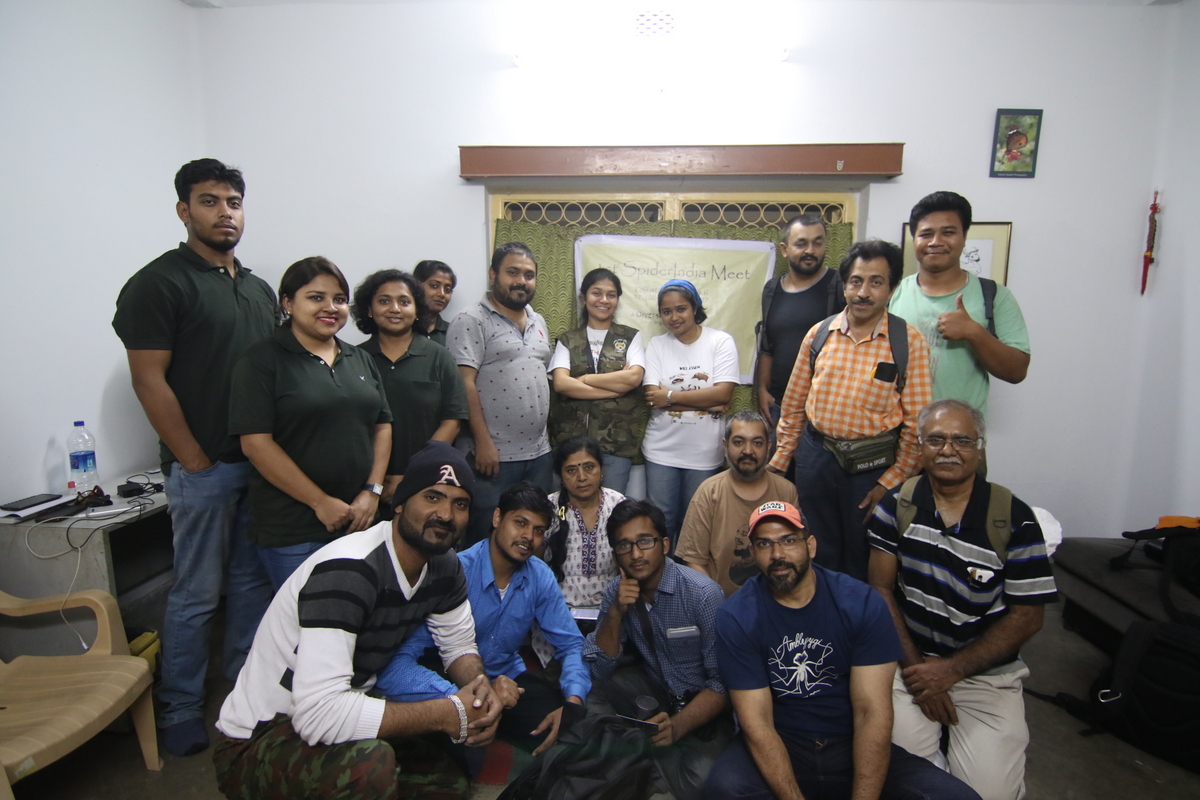
SpiderIndia Meet 2017 :: Kolkata, West Bengal

By Dr. Atul Vartak

The much awaited first SpiderIndia Meet was held in Kolkata, West Bengal from the 17th – 19th February 2017.

Stay was arranged in the Oasis Guest House in Jadavpur. Enthusiastic participants from different parts of the country started coming on from the 16th night and some arrived on 17th morning. About 20 enthusiasts from 6 States attended the meet.

On the first day 17th Feb all participants assembled at the Nature Mates office at Bijoygarh. Breakfast was followed by an introduction session by the participants. From there everyone was taken to ZSI (Zoological Survey of India) where we visited the Arachnology section first, spent time interacting with the PhD students and the staff. Also got to see a lot of specimens preserved from the British Indian Empire era. This was followed by a visit to different departments in ZSI and Lunch at the canteen. 


In the afternoon we proceeded for some fieldwork in the Botanical Gardens and the day concluded at the Nature Mates office where everyone made the days checklist.

The following two days, 18th and 19th were busy with a lot of fieldwork at 3 different sites. 18th Morning was spent in Central Park also known as the Banabitan followed by lunch on field. There after we proceeded to the Eco Park where participants had the paper presentation session. An online chat with Vijay Barve and Siddharth Kulkarni currently perusing PhD at the Washington University was very rewarding. A demonstration on Spider dissection was also organized at the same site.


19th morning participants were taken to the Chintamoni Kar Bird Sanctuary for fieldwork .The session concluded in the evening at the Nature Mates office where the participants were presented with participation certificates.

Approximately 12 Families 20  Genera were photo documented and a format for future documentation of spiders was discussed. A number of interesting spiders were photographed. Anepsion sp. , Ariamnes sp. Tylorida Sp. and many more!

Three days with spider enthusiasts… researchers... was a very satisfying with a lot of knowledge exchanged and new friends made. Overall a very good experience. A big thank you to the organizing team … Vijay Barve, Arjan Basu Roy and Team Nature Mates for successfully conducting this meet .

Looking forward for the next one.

Friday, January 27, 2017

Moths of India reaches 600 species

The Moths of India website has reached 600 species, an amazing achievement in just over 15 months since we went live. Some interesting moths posted in the last few months are...


The Zygaenid moth Psaphis euschemoides http://www.mothsofindia.org/sp/355920/Psaphis-euschemoides, which is an amazing mimic of another day flying Geometrid moth, the False Tiger MothDysphania militaris http://www.mothsofindia.org/sp/355022/Dysphania-militaris. Or is it the other way around?


The incredibly beautiful Zygaenid moth Campylotes-desgodinsi http://www.mothsofindia.org/sp/35591 2/Campylotes-desgodinsi

 
The Sea Buckthorn Hawkmoth Hyles hippophaes http://www.mothsofindia.org/sp/355943/Hyles-hippophaes, previously known from India only by a single specimen collected by Avinov in 1912. 


Orthobrachia hirowatarii, a species described in 2016 from China and Thailand, reported in India for the first time at http://www.mothsofindia.org/sp/355935/Orthobrachia-hirowatarii


The other highlight is that the number of contributors has increased to 40.

Keep “mothing" and contributing!

The Moths of India team

Sunday, September 15, 2013

Butterflies on your mind?

Published: 15th September 2013 12:00 AM
Last Updated: 13th September 2013 11:11 AM
    Vijay Barve (Photo: Vinod Kumar T)
It was love at first sight. Vijay Barve remembers all too well, the first time he saw the pupa of a common crow butterfly. It was like a shiny gold pendant, glimmering on an oleander plant, he recalls. Before this, he had witnessed a butterfly lay eggs. And that was, probably, the moment that would direct the course of his life. The boy who had begun to observe the lifecycles of butterflies soon joined the ranks of bonafide butterfly lovers and made it his life’s mission to spread awareness about the ubiquitous, brightly winged insect.
It is hardly surprising that Vijay grew up to be a butterfly expert. Childhood comprised of weekend bird watching trips with parents who were avid nature lovers. Raised to admire and observe the natural world, Vijay’s nature education was quite thorough.
A master’s degree in computer science from Pune University, followed by a stint with a scientific and research organization FRLHT (Foundation for Revitalisation of Local Health Tradition), further cemented his closeness to nature. At FRLHT, Vijay was involved in the distribution mapping of medicinal plants. And with plants came butterflies as a particular butterfly makes its home only on a certain plant to lay eggs. Broadening his scope of interest, Vijay did a course in entomology from the Bombay Natural History Society, of which he is a life-long member.
In 2001, Vijay started the Butterfly India Yahoo group. This e-initiative gave a platform to butterfly lovers (it has 1,500 members at present) across the country to share pictures and information.
“We may have butterfly experts like Isaac Kehimkar, Krushnamegh Kunte, Peter Smetacek and many others in India, but it’s Vijay who brought us together,” says Kolkata-based butterfly specialist, Arjan Basu Roy. “If butterfly watching/photography has become a popular form of nature study in India, significant credit goes to him.” Vijay also launched DiversityIndia Yahoo group that focuses on small invertebrates.
Besides this, Vijay has also created and has been managing cyber communities of naturalists interested in different biodiversity such as SpiderIndia, DragonflyIndia, IndianMoths, AmphibianIndia, ReptileIndia, InsectIndia, InvertebrateIndia, WildflowerIndia, GernCareerIndia and GreenLifestyleIndia.
Things thus chugged along in the virtual world, until Vijay and his friends came up with the idea of butterfly meets. “It was sometime in 2004 when we had the first butterfly meet, one in Kerala at the Shendurney Wildlife Sanctuary and another in Mumbai,” says Vijay. “Meets such as these fulfill a useful purpose—of bringing like-minded people together to do some fieldwork which led to sharing and learning techniques of identification, photography,” he explains. 
A job shift saw Vijay making his way to the University of Kansas, USA, where again he was able to coalesce his interest in biodiversity with his work. One experiment that he fondly remembers is the radio tagging of laboratory-raised monarch butterflies, a pioneering effort for sure. The monarch butterfly undertakes a spectacular migration, traversing thousands of kilometres from Canada to Mexico. “With our refined tracking system, we were able to track them for 10 miles,” he says.
Butterfly conservation, says Vijay, is essential. “The butterfly is an indicator species, it is sensitive to the environment. Greater numbers of butterflies in a region signify that the ecology is in good shape,” says Vijay, who lists the Blue Mormon butterfly as his favourite.
Vijay feels the best way to create interest in butterfly conservation is through the media and by constructing butterfly parks.

Original Post

Sunday, October 9, 2011

From slingshot kills to SLR shoots


Sunita Raghu


He might well have been a modern-day Angulimala. Only, instead of people he killed creatures—birds, reptiles and even amphibians. And while the compassion of the Buddha saved Angulimala, for Kolkata-bred Sajal Bar, the road to redemption has been quite different. As a veterinarian and animal activist, his karmic debts, if any, seem to have been repaid in full.


Today, Sajal is the toast of the birding/butterfly/reptile community, a great spotter as they say, and has most certainly come a long way since he played hunter. Ask him when he decided to trade in the slingshot for a camera, and he says, “I killed not for sport, but out of hunger, my family being too poor to keep me well-fed all the time. Hence a good many creatures ended up as my meal—birds, snakes, mongooses, palm civets, water monitors, Indian pond frogs, etc.” Once he killed a male spotted dove during the mating season and the female stayed put near the body. “I was overcome with remorse,” says Sajal. Around that time, well-meaning friends kept dragging him along for birding trips. Soon he joined an NGO called Nature Mates, and his mind was finally opened towards conservation and preservation. Says Sajal, “I owe everything I am today to Bikramadittya G Roy, president of Nature Mates who has taken me under his wing and even funded my expenses.”


Given his hunting background, the stocky 40-year-old’s choice of profession might seem paradoxical, but then again, perhaps it was meant to be. Recollects Sajal, “Once I got two Doberman puppies hoping to raise and sell them for a profit. However, both developed severe diarrhoea and one even succumbed to it for want of a vet who could administer the puppy saline.” Saddened by the loss, Sajal decided to become a vet himself. Easier said than done, considering that he had hardly any education worth the name! However, just by observing and learning under a trained vet, he learnt the ropes of the job. Soon, NGOs were knocking at his door to help save injured animals and even birds. “The other day, I managed to plaster together the broken wing of a Coppersmith Barbet,” he says. Neutering street dogs and cats is another line of work.


His love for nature and photography sees him rising with the birds and going to a nearby forest where he spends time spotting and photographing all living creatures. “Sajal has a keen eye; he is indeed an asset to the birding community,” says his naturalist-friend Arjan Basu Roy. It’s a sentiment shared by avid birder and wildlife photographer Sumit Sen, who feels that Sajal is a good observer of behaviour and patterns and by recording everything, gives an opportunity to others to interpret the same. Vijay Barve, moderator of the e-group ButterflyIndia, says that Sajal is amazingly good at spotting insects and myriad small creatures.


The proudest moment in Sajal’s career must have been when he shot a picture of the Black-browed Reed Warbler in the reed beds of Joka. It was an extraordinary feat, when one considers that prominent American ornithologist Pamela Rasmussen said in her book Birds of South Asia that its presence in India was ‘hypothetical’.


Full Story

Tuesday, July 27, 2010

BIM ends with ‘breakfast with butterflies

MIAO, July 23: The Butterfly India Meet, Namdapha 2010 ended with a Conservation program named, “Breakfast with Butterflies” here at Miao yesterday. The five-day assembly of Natures mates finally comes to an end with around 183 findings of flying beauties and innumerous Moths apart from the sightings of some glittering beetles like Golden Tortoise Beetle.
Twenty numbers of selected school children from five schools around the Miao attended the program --“Breakfast with Butterflies,” a unique program on awareness with the theme ‘Lets Create a Flutter’. Experts took the children to nearby fields as rain God restricted the movement to distant areas, to give them some basic information about the beautiful creatures living around us. Some senior photographers provided opportunity to school children to try their tiny hands on their long zooms and describe the shooting techniques. Children had never imagined believing their luck when they got the chance to actually shooting with cameras which they were only watching in TV Channels. “This was an encouraging indicator for existence of many other species of the butterflies in the core area and beyond that when type of forests and profile of hill changes, if count touches a figure of 183 in the buffer area” explained Dr. Alfred, Former Director, Zoological Survey of India.  J. M. Garg who is an Indian icon in Wikipedia for his submission of more than 8000 pictures of different Nature categories was amazed to see the diversity of Arunachal Pradesh. “For sure I am taking another trip to this wonderland soon where ecology appears still intact while people from other part of the country struggling to breathe in fresh air in polluted environment” he added.  
While speaking on the occasion of ‘Lets Create a Flutter’ Mrs. J. Jugli, Chairperson, Changlang Zila Parishad expressed the need of carrying the conservation awareness to deep inside the villages with help of Anchal members. “More programs like this should be organized in future on regular intervals to educate the ignorant masses” she added. Lauding the spirit of participants and initiations of organizers of the meet, Mrs. Jugli said, ‘We were not aware of our rich biodiversity which have been highlighted’
“The event was held for the thirteenth time at the various locations of India and this is the second time we have got the opportunity to explore Arunachal Pradesh in North East” explained Butterfly India Group Moderator Vijay Barve in his introductory speech. He thanked  Arif Siddiqui, program coordinator whose butterflies’ pictures draw the attention of Nature Enthusiast towards the Arunachal Pradesh worldwide.  “Still people are desperate to come to Arunachal Pradesh for its wonderful wildlife but we could not entertain many due to limitations in accommodation” he added.
Colonel Sandeep Chaudhury of 18 Assam Rifles, Jairampur speaking to the gathering urged for controlling hunting of animals and birds in the area. “Poachers should be suing for the killing animals in the similar manner as the murderer are treated in civil societies” he added. S.J. Jongsam Namdapha national park filed director, cherished the efforts of participants and regret for the bad weather since last three month which restricted the movement of visiting experts to the inner areas of Park. He also assured to provide all support and help to any research scholars and teams coming for studies in the park in future also.  
“Despite belonging to a completely different profession, Col Choudhury has shown his appreciation for nature and affection for the people of this area,” said Nimbong Sena. Assam Rifle was one of the main supporters in organizing the Butterfly India Meet. All the participants were extremely happy and expressed their gratitude to the peoples of Arunachal Pradesh for the hospitality they received here. “This will be an inerasable moment of our life and we are much thankful to organizing NGO NSEWC and SEACOW” said Siddarth Edake of Madhya Pradesh.
The event was witnessed by officials of various departments including department of Forest and Environment, GeoEnpro, Assam Rifles,  local administration and local leaders.

Friday, September 25, 2009

Butterfly India Meet to be Held in Goa

Written by BHIVA P PARAB
Thursday, 24 September 2009 01:54
t is time for butterfly lovers to rejoice, for the Butterfly India Meet will be held in Goa this year.

The meet, which will be held at Bondla from September 26 to September 30 will have field trips to the forests of Bondla. The programme also includes visits to the forests of Tambdi Surla and Netravali and the forests around the Dudhsagar Waterfall. During the meet various field workers will present their work at the evening session that will be held at the base-camp.
Butterflies are amongst the most beautiful creatures on earth. Goa possesses a great diversity in butterfly species. The butterflies in Goa belong to the Phylum Arthropoda (arthro meaning jointed or segmented and poda meaning feet or appendages) and Order Lepidotera (lepis meaning scale and pteron meaning wing). These insects are pollinating agents, besides they form a part of the food chain components of birds, spiders and other predatory insects.
The Moth Meet will be combined with the Butterfly India Meet and this will prove to be a good opportunity for butterfly and moths lovers of Goa as they will get a common platform to interact with butterfly lovers from all over the country.
“This 9th Annual Meet is set to be unique since it has been planned to combine the Moth Meet with the Butterfly meet. Light-trapping will be done at night to study moths and this event is important since the moth diversity in Goa is virtually unexplored and it is expected to arrive at a fairly comprehensive list for moths of Bondla,” said Mr Parag Rangnekar who is coordinating the meet informed. He further added, “This meet is a good opportunity for the butterfly and moth enthusiasts in Goa to learn from experts in the field.”
“The Ghats in Goa are the confluence of the Northern and the Southern Western Ghats, thus species representative of southern Ghats make their presence felt in Goa. Omkar Dharwadkar and I recently reported three butterflies for Goa hitherto known only to be found in Southern India. More detailed surveys are expected to throw light on more species that have not been reported till now,” Mr Rangnekar said.
“It all begun on October 4, 2001 when Mr Vijay Barve initiated the Butterfly India yahoo group for networking and sharing knowledge between butterfly researchers and enthusiasts. The group has grown and presently has 1064 members. It was during discussions over the e-group that a decision was made to organise the Butterfly India Meet in order to make a transition from the virtual world to the real one and actually meet on the field to share knowledge and experiences. The first meet was held in 2001,” he said
“The e-group has members from various fields, from serious researchers like Krushnamegh Kunte, field workers like Dr Kalesh, Kalluri Subramanian, Amol Patwardhan, Milind Bhakare to nature enthusiasts and wildlife photographers,” he added.

Story

Saturday, June 13, 2009

Monarchs get radio tags

High hopes pinned on tiny creatures
National Geographic film crew members Charlie Miller, from left, Eddie O’Connor and Bob Poole grab footage as Martin Wikelski, associate professor of ecology and evolutionary biology at Princeton University, and Chip Taylor, director of Monarch Watch, attach a radio transmitter tag to a monarch butterfly Wednesday at the Lawrence Municipal Airport. National Geographic came along to film the tagging and tracking process for a segment on migrations.

National Geographic film crew members Charlie Miller, from left, Eddie O’Connor and Bob Poole grab footage as Martin Wikelski, associate professor of ecology and evolutionary biology at Princeton University, and Chip Taylor, director of Monarch Watch, attach a radio transmitter tag to a monarch butterfly Wednesday at the Lawrence Municipal Airport. National Geographic came along to film the tagging and tracking process for a segment on migrations.


May 21, 2009

History was made Wednesday in Lawrence, and it was all due to some winged visitors making their way through town.

“What we’re going to try to do is something that’s never been done before, and that’s put radio tags on monarch butterflies, try to get them to fly. Hopefully, we’ll be able to follow them in the airplane and see where they go,” said Chip Taylor, director of Monarch Watch at Kansas University.

Martin Wikelski, associate professor of ecology and evolutionary biology at Princeton University and Chip Taylor, director of Monarch Watch attach a radio transmitter tag to a monarch butterfly Wednesday, May 20, 2009 at the Lawrence Municipal Airport. Taylor and Wikelski attached the tracking device to several monarchs to test the piece of microtechnology in the field. National Geographic came along to film the tagging and tracking process for a segment on migrations.

Martin Wikelski, associate professor of ecology and evolutionary biology at Princeton University and Chip Taylor, director of Monarch Watch attach a radio transmitter tag to a monarch butterfly Wednesday, May 20, 2009 at the Lawrence Municipal Airport. Taylor and Wikelski attached the tracking device to several monarchs to test the piece of microtechnology in the field. National Geographic came along to film the tagging and tracking process for a segment on migrations.

Lawrence is a regular stop for the butterflies on their northward migration from Mexico.

National Geographic was in town to film the radio tagging for a new series, “Great Migration.”

Princeton University professor and biologist Martin Wikelski has used radio transmitters to track the journeys of other species, but never before has the migration of the monarch been investigated using this technology.

Wikelski, Taylor and the National Geographic crew were at the Lawrence Municipal Airport with their six-legged subjects. First, they fed the butterflies to make sure they had energy to carry the transmitters that would be attached to their bodies. The transmitters weigh about half as much as a butterfly does, which Taylor described as “startling” to the butterfly.

After releasing a newly accessorized butterfly, Taylor and Wikelski went up in a two-passenger plane for about 45 minutes to follow its signal.

“It moved a little bit to the north-northeast, which is what we expected,” said an excited Taylor post-flight.

They will be releasing more butterflies today in, hopefully, less windy conditions.

“This is the first step, and after we get through (Thursday), we’ll talk about where to take this then,” Taylor said.

Radio Tagging Monarch Butterflies by Vijay Barve

LJWorkd