Showing posts with label Nature Mates. Show all posts

Sunday, March 4, 2018

Biodiversity Meet, Nagaland 2018


Butterflies & moths, birds, odonates, spiders, amphibians & reptiles, cicadas and more…

Sukhai, Ghukhuyi & Kivikhu, Zunheboto District, Nagaland

Dates: 9th May to 16th May 2018

Costs: Rs.16,500/- per person (for Indian citizens), ex Dimapur, including food, stay vehicle hire on all days on first come, first served basis by transferring 50% of the contributory amount to the
bank account below:


Bank details:

Send your contributory amount to
Account name: TITLI
Bank name: State Bank of India
Address: Jakhan, Dehradun
Current account number: 31058150506
IFSC code: SBIN0006155


And email your deposit details to sanjay.sondhi1@gmail.com


Maximum capacity: 16 people

About the biodiversity meet

This Biodiversity Meet is being organised to learn and document the biodiversity of Sukhai, Ghukhuyi and Kivikhu villages in Zunheboto District, Nagaland. Pia Sethi and her team from the The Energy & Resources Institute (TERI) has been working in this landscape for the last three years. As an outcome of their efforts, the three villages above have voluntarily formed Community Conserved Areas (CCAs) in order to protect their forests and associated biodiversity. Since the beginning of 2017, Titli Trust has been supporting TERI to assess the area’s biodiversity, as well as to evaluate the opportunity to initiate nature-linked tourism as an incentive to conserve. More than 200 species of birds, 120 species of butterflies, 200 species of moths have already been documents with many endemics. At this point in time, there is no tourism infrastructure in this area, and the Biodiversity Meet participants will be staying in homes of villagers.

Meet organisers

The meeting is being organised on a voluntary basis by TERI, Titli Trust, DiversityIndia, NatureMates and Indian Foundation for Butterflies. All proceeds from the meet will go to the local communities.

Inclusions:


  • Boarding at Sukhai, Ghukhuyi and Kivikhu villages.
  • 3 meals per day (breakfast, lunch & dinner). Non vegetarian meals are included.
  • Vehicle hire for the duration of the meet (4 people to a vehicle).
  • Arranging for ILP’s.
  • Local guides.

Exclusions:

  • Personal expenses such as tips, phone bills, bottled water & bottled beverages.
  • Rail and/or airfare to and from Dimapur.
  • Insurance and medical claims.
  • Lunch on the last day.

Participants need to arrive at Dimapur airport on 9th May 2018 by 1230 hrs.
Participants will be dropped off at Dimapur airport on 16th May 2018 by 1100 hrs.


Accommodation:

Village homes at Sukhai, Ghukhuyi and Kivikhu on a shared basis.

Visit day-to-day schedule:


  • 9th May 2018: Departure from Dimapur airport at 1300 hrs. 10 our drive to Sukhai.
  • 10, 11th May 2018: Sukhai village & surrounds. 11th May travel to Ghukhuyi (5 km, 20 minutes).
  • 12th, 13th May 2018: Ghukhuyi & surrounds. 13th May travel to Kivikhu (25 km, 1.5 hours)
  • 14, 15th May 2018: Kivikhu & surrounds. 15th May late afternoon travel to Wokha/Kohima.
  • 16th May 2018: travel to Dimapur

Schedule of activities (based on participants):


  • Brief about the area; interaction with the Sema tribe and their conservation plans.
  • Trails for butterfly, bird and other faunal group daily.
  • Moth/insect screens every night.
  • “Herp” walks at night.
  • Identification sessions for various species’ groups in the evening.
  • Upload of information on various NCBS/IFB websites.

Contacts for this Biodiversity meet:

  • Sanjay Sondhi, Titli Trust, sanjay.sondhi1@gmail.com, +91 9412052189
  • Pia Sethi, TERI, pias@teri.res.in, +91 9811222321
  • Vijay Barve, DiversityIndia, vijay.barve@gmail.com, +91 9845724832  (What'sApp and Telegram)
  • Krushnamegh Kunte, IFoundButterflies, krushnamegh@ifoundbutterflies.org

Monday, March 6, 2017

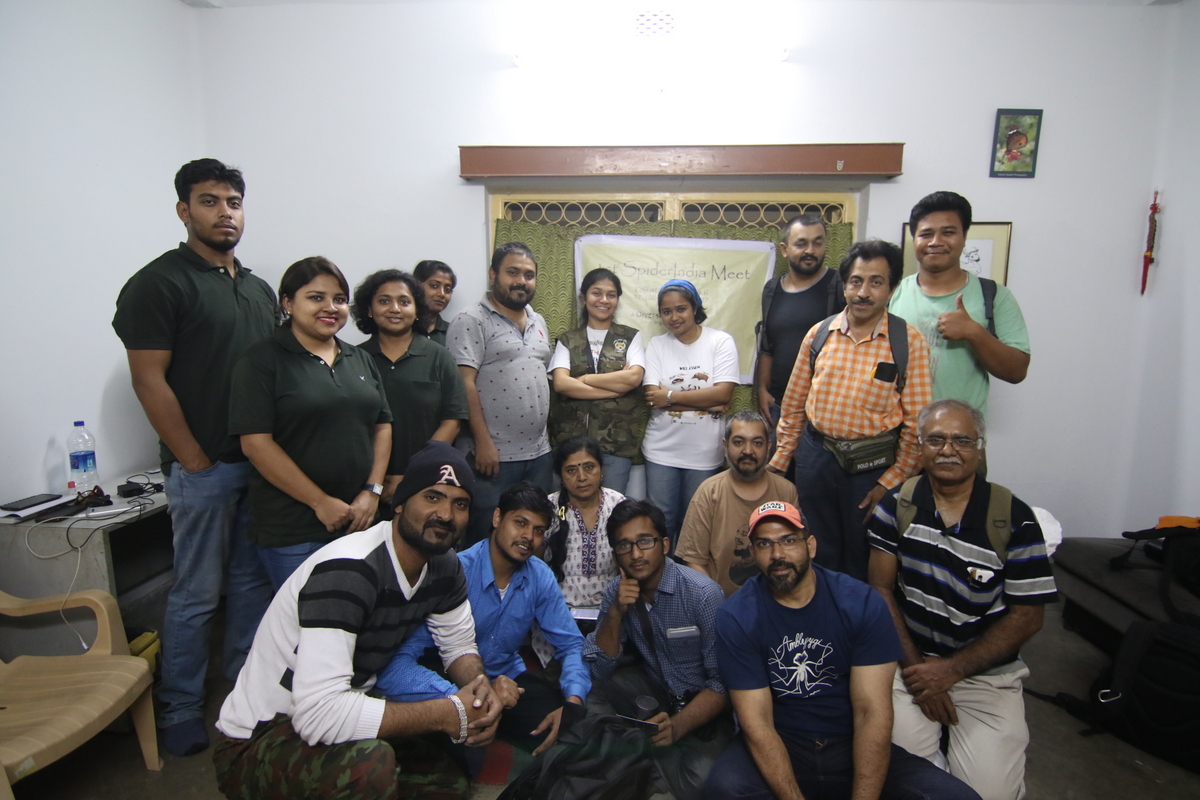
SpiderIndia Meet 2017 :: Kolkata, West Bengal

By Dr. Atul Vartak

The much awaited first SpiderIndia Meet was held in Kolkata, West Bengal from the 17th – 19th February 2017.

Stay was arranged in the Oasis Guest House in Jadavpur. Enthusiastic participants from different parts of the country started coming on from the 16th night and some arrived on 17th morning. About 20 enthusiasts from 6 States attended the meet.

On the first day 17th Feb all participants assembled at the Nature Mates office at Bijoygarh. Breakfast was followed by an introduction session by the participants. From there everyone was taken to ZSI (Zoological Survey of India) where we visited the Arachnology section first, spent time interacting with the PhD students and the staff. Also got to see a lot of specimens preserved from the British Indian Empire era. This was followed by a visit to different departments in ZSI and Lunch at the canteen. 


In the afternoon we proceeded for some fieldwork in the Botanical Gardens and the day concluded at the Nature Mates office where everyone made the days checklist.

The following two days, 18th and 19th were busy with a lot of fieldwork at 3 different sites. 18th Morning was spent in Central Park also known as the Banabitan followed by lunch on field. There after we proceeded to the Eco Park where participants had the paper presentation session. An online chat with Vijay Barve and Siddharth Kulkarni currently perusing PhD at the Washington University was very rewarding. A demonstration on Spider dissection was also organized at the same site.


19th morning participants were taken to the Chintamoni Kar Bird Sanctuary for fieldwork .The session concluded in the evening at the Nature Mates office where the participants were presented with participation certificates.

Approximately 12 Families 20  Genera were photo documented and a format for future documentation of spiders was discussed. A number of interesting spiders were photographed. Anepsion sp. , Ariamnes sp. Tylorida Sp. and many more!

Three days with spider enthusiasts… researchers... was a very satisfying with a lot of knowledge exchanged and new friends made. Overall a very good experience. A big thank you to the organizing team … Vijay Barve, Arjan Basu Roy and Team Nature Mates for successfully conducting this meet .

Looking forward for the next one.

Sunday, March 15, 2015

New butterfly species spotted in West Bengal


In a significant addition to the butterfly species in India, wildlife enthusiasts have found the Malayan Green Banded Peacock (Papilio palinurus), a beautiful specimen found in South East Asia, for the first time in India.

The butterfly with a dusty green base having a bluish green band spread over both wings in the shape of an arc is found in southern Myanmar and peninsular Thailand south-eastward into Borneo and the Philippines.

“We have spotted it at Chintamani Kar Bird Sanctuary in West Bengal’s South 24 Parganas on a few occasions but were unable to confirm because it could not be photographed. Finally, after taking photographs and confirmation by experts, we can now safely declare that we have a new species from India,” Arjan Basu Roy, secretary of Nature Mates-Nature Club, told The Hindu.

The record of the newly found butterfly has been published by Arjan Basu Roy, Subhankar Patra and Krushnamegh Kunte on the website ifoundbutterflies.org.

In 2004, the butterfly was also recorded from Bangladesh by eminent lepidopterist T. Larsen. The sanctuary where the butterfly has been recorded has about 80 species of the butterflies, according to a recent survey. Referred to as the “flagship species,” butterflies are not only pollinators of flowering plants, but also useful in monitoring environmental changes.

While there are about 600 known species of butterflies in West Bengal, India is home to about 1,500 species of butterflies. With this new find, there has been an addition to different peacock butterflies which are characterised by their powdery green pigments. West Bengal is probably the only State which is home to a wide variety of peacock butterflies such as the rare Krishna Peacock, Blue Peacock, the relatively common Paris Peacock, Common Peacock and Common Banded Peacock. The only other Peacock butterfly found in the country is Buddha Peacock or Malabar Banded Peacock, which is endemic to south India.

Species page on Butterflies of India


Tuesday, October 11, 2011

Feel the pulse of the ecosystem from the flutter of butterflies

By Lesley D Biswas   Kolkata
11 Oct 2011


The presence of butterflies indicates a healthy ecosystem and to ensure that his City of Joy bathes in a rainbow of flutter, Arjan Basu Roy, the secretary of Nature Mates, a Kolkata based organization working to sensitize people about nature, and the West Bengal Forest Department (WBFD) have developed Banabitan Butterfly Garden in Salt Lake.

Roy has also been associated with other butterfly garden projects to conserve butterflies in eastern India at Suntalekhola, Chilapata Eco-tourism zone and Tiya Bon, all initiatives by the Directorate of Forest, government of West Bengal.

“Butterflies are the most prominent bio-diversity indicators,” points out Roy. “Through them you can understand whether the bio-diversity of a region is secure or not. Where there are butterflies the ecosystem is secure and human beings who comprise the largest component of the ecosystem are not under threat. If butterflies dwindle, mankind will be the worst hit,” he adds.

Butterflies are not merely beautiful fluttering creatures, but are the most prominent bio-diversity indicators, according to Arjan Basu Roy 
Luckily, Kolkata is still a rich haven for butterflies with an impressive 120 to 150 species. As a result of Roy’s passion Banabitan Butterfly Garden in Salt Lake’s central park is a pretty colourful maze of butterflies happily frolicking sweet scented nectar plants like lantana, periwinkle, cosmos and hibiscus. Butterflies need larval food plants on which they lay their eggs and caterpillars feed and nectar plants for the butterflies to feed. With species like blue tiger, plain barred owl and more common species like plain and glassy tigers, common yellow and common five rings already visiting, providing them a habitat rich in nectar and host plants make it possible for them to multiply.

Roy’s initiative to conserve butterflies is also working as a catalyst to conserve some of the predators like birds and lizards who feed on butterflies. “We have noticed a steady increase in the mynah, jungle babbler and black drongo,” says Roy, who inherited his appreciation for wildlife from his father Ajoy Basu Roy.

To sustain his family Roy was forced to put his passion on hold and start a printing business. A qualified engineer with three diplomas in engineering including one from the renowned Regional Institute of Printing Technology (RIPT), Roy had no idea then that he was destined for greater things.

Interestingly, Roy’s induction into conservation came accidentally in 2004 when he took an order to print brochures for the WBFD. He came into contact with officials in the forest department who shared a thirst for conserving nature and in July 2005 Roy was included in a project by West Bengal Forest Development Corporation Ltd. to develop Gar Panchakot in Purulia as a destination for traditional herbal treatment.

Though he started out as a wildlife photographer Roy found himself restrained as he could not afford a big lenses camera, imperative for wildlife photography. But, on first May 2005 Roy got an idea. “I was standing in Garpanchkot in Purulia when a beautiful butterfly of the Diana species caught my fancy. The micro-lenses required to photograph butterflies was within my capacity.” And then, as he puts it, “I decided to photograph butterflies and ultimately began conserving them.”

Full Story

Sunday, October 9, 2011

From slingshot kills to SLR shoots


Sunita Raghu


He might well have been a modern-day Angulimala. Only, instead of people he killed creatures—birds, reptiles and even amphibians. And while the compassion of the Buddha saved Angulimala, for Kolkata-bred Sajal Bar, the road to redemption has been quite different. As a veterinarian and animal activist, his karmic debts, if any, seem to have been repaid in full.


Today, Sajal is the toast of the birding/butterfly/reptile community, a great spotter as they say, and has most certainly come a long way since he played hunter. Ask him when he decided to trade in the slingshot for a camera, and he says, “I killed not for sport, but out of hunger, my family being too poor to keep me well-fed all the time. Hence a good many creatures ended up as my meal—birds, snakes, mongooses, palm civets, water monitors, Indian pond frogs, etc.” Once he killed a male spotted dove during the mating season and the female stayed put near the body. “I was overcome with remorse,” says Sajal. Around that time, well-meaning friends kept dragging him along for birding trips. Soon he joined an NGO called Nature Mates, and his mind was finally opened towards conservation and preservation. Says Sajal, “I owe everything I am today to Bikramadittya G Roy, president of Nature Mates who has taken me under his wing and even funded my expenses.”


Given his hunting background, the stocky 40-year-old’s choice of profession might seem paradoxical, but then again, perhaps it was meant to be. Recollects Sajal, “Once I got two Doberman puppies hoping to raise and sell them for a profit. However, both developed severe diarrhoea and one even succumbed to it for want of a vet who could administer the puppy saline.” Saddened by the loss, Sajal decided to become a vet himself. Easier said than done, considering that he had hardly any education worth the name! However, just by observing and learning under a trained vet, he learnt the ropes of the job. Soon, NGOs were knocking at his door to help save injured animals and even birds. “The other day, I managed to plaster together the broken wing of a Coppersmith Barbet,” he says. Neutering street dogs and cats is another line of work.


His love for nature and photography sees him rising with the birds and going to a nearby forest where he spends time spotting and photographing all living creatures. “Sajal has a keen eye; he is indeed an asset to the birding community,” says his naturalist-friend Arjan Basu Roy. It’s a sentiment shared by avid birder and wildlife photographer Sumit Sen, who feels that Sajal is a good observer of behaviour and patterns and by recording everything, gives an opportunity to others to interpret the same. Vijay Barve, moderator of the e-group ButterflyIndia, says that Sajal is amazingly good at spotting insects and myriad small creatures.


The proudest moment in Sajal’s career must have been when he shot a picture of the Black-browed Reed Warbler in the reed beds of Joka. It was an extraordinary feat, when one considers that prominent American ornithologist Pamela Rasmussen said in her book Birds of South Asia that its presence in India was ‘hypothetical’.


Full Story