Showing posts with label Siddharth Kulkarni. Show all posts

Monday, March 6, 2017

SpiderIndia Meet 2017 :: Kolkata, West Bengal

By Dr. Atul Vartak

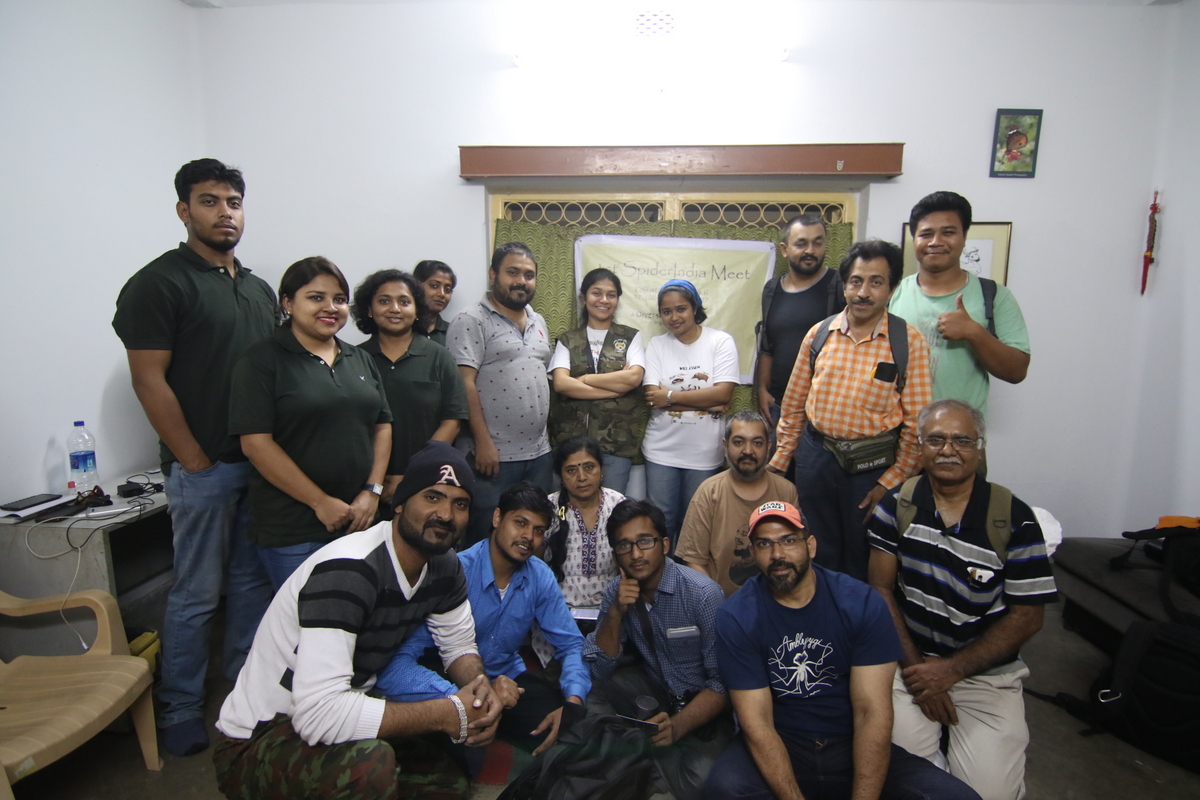
The much awaited first SpiderIndia Meet was held in Kolkata, West Bengal from the 17th – 19th February 2017.

Stay was arranged in the Oasis Guest House in Jadavpur. Enthusiastic participants from different parts of the country started coming on from the 16th night and some arrived on 17th morning. About 20 enthusiasts from 6 States attended the meet.

On the first day 17th Feb all participants assembled at the Nature Mates office at Bijoygarh. Breakfast was followed by an introduction session by the participants. From there everyone was taken to ZSI (Zoological Survey of India) where we visited the Arachnology section first, spent time interacting with the PhD students and the staff. Also got to see a lot of specimens preserved from the British Indian Empire era. This was followed by a visit to different departments in ZSI and Lunch at the canteen. 


In the afternoon we proceeded for some fieldwork in the Botanical Gardens and the day concluded at the Nature Mates office where everyone made the days checklist.

The following two days, 18th and 19th were busy with a lot of fieldwork at 3 different sites. 18th Morning was spent in Central Park also known as the Banabitan followed by lunch on field. There after we proceeded to the Eco Park where participants had the paper presentation session. An online chat with Vijay Barve and Siddharth Kulkarni currently perusing PhD at the Washington University was very rewarding. A demonstration on Spider dissection was also organized at the same site.


19th morning participants were taken to the Chintamoni Kar Bird Sanctuary for fieldwork .The session concluded in the evening at the Nature Mates office where the participants were presented with participation certificates.

Approximately 12 Families 20  Genera were photo documented and a format for future documentation of spiders was discussed. A number of interesting spiders were photographed. Anepsion sp. , Ariamnes sp. Tylorida Sp. and many more!

Three days with spider enthusiasts… researchers... was a very satisfying with a lot of knowledge exchanged and new friends made. Overall a very good experience. A big thank you to the organizing team … Vijay Barve, Arjan Basu Roy and Team Nature Mates for successfully conducting this meet .

Looking forward for the next one.

Wednesday, February 1, 2017

Rare spider spotted in a remote hospital in Assam through activities of a School Nature Club

An article was published recently in the Biodiversity Data Journal entitled, “Report of Platythomisus octomaculatus (C. L. Koch, 1845) and Platythomisus sudeepi Biswas, 1977 from India (Araneae, Thomisidae)”. The first species, P. octomaculatus, is being recorded after 120 years of its last report and its distribution has been extended to Assam in India from its previously known distributions in Java and Sumatra. The article was published by Ms. Swara Yadav, a zoologist from Satara, Maharashtra and Dr. Vijay Anand Ismavel, the Medical Superintendent of the Makunda Christian Leprosy & General Hospital (www.makunda.in) in the Karimganj District of Assam. Mr. Vinayak Patil from the College of Forestry in Dapoli, Maharashtra had also found another species in the same genus, P. sudeepi, and this observation is also discussed and reported in the same paper.
The Assam observation was possible through the activities of the “Makunda Nature Club”. Dr. Vijay Anand Ismavel had been working in the Makunda hospital (a mission hospital situated in a remote part of Assam, bordering Mizoram and Tripura) since 1993. He started photographing and documenting biodiversity in and around the campus in 2009 (shortly after suffering a heart attack). Over the next 7 years, he documented over 5300 observations (of nearly 2000 different species) – all of them uploaded to iNaturalist with over 10,000 supporting photographs - http://www.inaturalist.org/people/8853. Most of them are also posted to the different iNaturalist groups of DiversityIndia.
 In 2015, Dr. Vijay Anand founded the “Makunda Nature Club” – this is formed with some staff members (postgraduate teachers in Botany, Zoology and Biotechnology of the Makunda Christian Higher Secondary School -  a school run by the Hospital Society with over 900 children studying upto Class XII in Arts/Science) and about 30 student members. A seminar on Forest Conservation was the first activity – tree-planting and a talk by Padma Shri Jadav Payeng, the “Forest Man of India”. The club then organized a biodiversity documentation workshop conducted by Mr. Rohit George from Indian BiodiversityPortal (IBP) at Makunda and following this a “Makunda Nature Club” group was also formed on IBP to enable members to upload photos from their cellphones directly using the IBP App. Mr. Siddharth Kulkarni, an arachnologist from Pune who is also the Country Coordinator for India on the World Spider Catalog (he is presently pursuing his Ph.D in Arachnology at the George Washington University in the USA) then conducted a workshop on “Basic Arachnology” for the Club members. A few months later, Mr. Siddharth Kulkarni and Ms. Swara Yadav were  invited to Makunda to spend time with the Club members in doing a survey of spider biodiversity in the 350 acre campus of the hospital. Members learnt about spider families, habits and how to identify different species. The hospital purchased a stereo-microscope for the Club so that identification of spiders could be done in the school science laboratory. It was during this survey, that two specimens of Platythomisus octomaculatus were found (one by Antina Pasyad, a student from Class 8 of the school and the other by Rejoice Gassah, who has joined the hospital as a full-time staff of the Club – he was a student of Makunda’s School and is now pursuing his BA – both of them belong to the Jaintia tribe and their families live in jungle villages close to the hospital). One of the spiders had an egg-sac – members observed spider-lings emerge and grow over several days till they dispersed. Further scientific work on confirmation of the identification was done by Ms. Swara Yadav and Mr. Siddharth Kulkarni leading to the publication.
The Makunda Nature Club is probably the only (or one of the few) nature clubs in schools in India that inform and engage student members in actual professional scientific research in surrounding forests.  This creates an awareness of the different life forms that exist, their interdependence with each other and leads children to appreciate their beauty as well as the need to conserve forests and all the species that forests support. It also stimulates the curiosity of children and inculcates an interest to learn more about the species that are observed and adds meaning to the biology subjects that they study in class. A few children, having been exposed to observation and documentation of biodiversity may decide to pursue it as a career.
In 2015, Dr. Vijay Anand and some members of the Club found a male van Hasselt Sunbird (Leptocoma brasiliana) in surrounding forests – this species has now been found in the hospital campus as well. This was the first time this species had been photographed in present-day India and this observation was published in Indian Birds by Dr. Vijay Anand (along with Mr. Praveen Jayadevan, a researcher from Bangalore). We hope that in the years to come, more such discoveries would be made and citizen science initiatives such as the “Makunda Nature Club” would make significant contributions to existing knowledge on biodiversity.


Thursday, November 21, 2013

A new species of spiders discovered in Satara

In 2010, when two researchers were busy observing migratory birds at a dam near Satara, Maharashtra, they spotted a distinct spider with a red stripe on its back. However, they just took a picture of it and left. "When we later researched this particular spider, we found out that it was called the Red-back spider. It had its origin in Australia but they were few records of it in India. We reported its existence in Satara district and this gradually got us interested in spiders," says Sidharth Kulkarni, who, along with his colleague Dr V Y Deshpande, spends much of his time at the zoology department of the Yashwantrao Chavan Institute of Satara (YCIS) studying spiders. 

 Image form Animal Discoveries 2012, ZSI

The two have now discovered a new species that belongs to the family of lynx spiders scientifically known as Oxyopidae. They have decided to name it Oxyopes Sataricus, after the Satara region.
The scientists, who are studying spider diversity in western Maharashtra, have worked together on chronicling the life stages of the Red-back spider Latrodectus hasselti, recording the scorpion-tailed spider for the first time in Maharashtra and some lynx spiders for the first time in India. "We are also hoping to study spiders as agents for controlling pests," says Deshpande. "Various spiders feed upon specific pests. Hence this research could bring out a natural and cost-free solution and possibly an alternative to chemical pesticides," says Kulkarni. 

Spiders belong to the class Arachnida and not Insecta. "The basic differentiation between these two classes is that the cephalic (head) and thoracic (thorax) region is fused in class Arachnida and called cephalothorax. Insects usually have antennae and three pairs of legs while in spiders, antennae are absent and they have four pairs of legs," says Kulkarni, adding that the ecological importance of the spiders is distinct from that of insects. 

Ref: