Showing posts with label Arjan Basu Roy. Show all posts

Monday, March 6, 2017

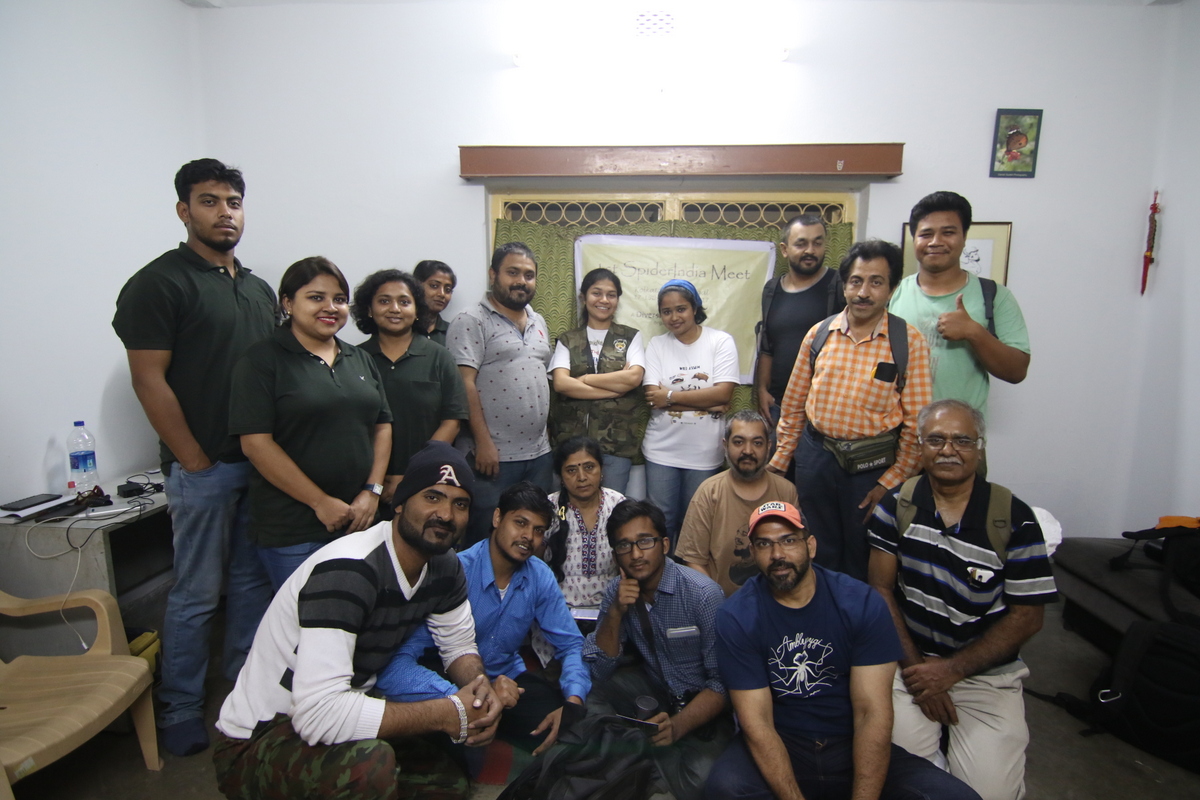
SpiderIndia Meet 2017 :: Kolkata, West Bengal

By Dr. Atul Vartak

The much awaited first SpiderIndia Meet was held in Kolkata, West Bengal from the 17th – 19th February 2017.

Stay was arranged in the Oasis Guest House in Jadavpur. Enthusiastic participants from different parts of the country started coming on from the 16th night and some arrived on 17th morning. About 20 enthusiasts from 6 States attended the meet.

On the first day 17th Feb all participants assembled at the Nature Mates office at Bijoygarh. Breakfast was followed by an introduction session by the participants. From there everyone was taken to ZSI (Zoological Survey of India) where we visited the Arachnology section first, spent time interacting with the PhD students and the staff. Also got to see a lot of specimens preserved from the British Indian Empire era. This was followed by a visit to different departments in ZSI and Lunch at the canteen. 


In the afternoon we proceeded for some fieldwork in the Botanical Gardens and the day concluded at the Nature Mates office where everyone made the days checklist.

The following two days, 18th and 19th were busy with a lot of fieldwork at 3 different sites. 18th Morning was spent in Central Park also known as the Banabitan followed by lunch on field. There after we proceeded to the Eco Park where participants had the paper presentation session. An online chat with Vijay Barve and Siddharth Kulkarni currently perusing PhD at the Washington University was very rewarding. A demonstration on Spider dissection was also organized at the same site.


19th morning participants were taken to the Chintamoni Kar Bird Sanctuary for fieldwork .The session concluded in the evening at the Nature Mates office where the participants were presented with participation certificates.

Approximately 12 Families 20  Genera were photo documented and a format for future documentation of spiders was discussed. A number of interesting spiders were photographed. Anepsion sp. , Ariamnes sp. Tylorida Sp. and many more!

Three days with spider enthusiasts… researchers... was a very satisfying with a lot of knowledge exchanged and new friends made. Overall a very good experience. A big thank you to the organizing team … Vijay Barve, Arjan Basu Roy and Team Nature Mates for successfully conducting this meet .

Looking forward for the next one.

Sunday, March 15, 2015

New butterfly species spotted in West Bengal


In a significant addition to the butterfly species in India, wildlife enthusiasts have found the Malayan Green Banded Peacock (Papilio palinurus), a beautiful specimen found in South East Asia, for the first time in India.

The butterfly with a dusty green base having a bluish green band spread over both wings in the shape of an arc is found in southern Myanmar and peninsular Thailand south-eastward into Borneo and the Philippines.

“We have spotted it at Chintamani Kar Bird Sanctuary in West Bengal’s South 24 Parganas on a few occasions but were unable to confirm because it could not be photographed. Finally, after taking photographs and confirmation by experts, we can now safely declare that we have a new species from India,” Arjan Basu Roy, secretary of Nature Mates-Nature Club, told The Hindu.

The record of the newly found butterfly has been published by Arjan Basu Roy, Subhankar Patra and Krushnamegh Kunte on the website ifoundbutterflies.org.

In 2004, the butterfly was also recorded from Bangladesh by eminent lepidopterist T. Larsen. The sanctuary where the butterfly has been recorded has about 80 species of the butterflies, according to a recent survey. Referred to as the “flagship species,” butterflies are not only pollinators of flowering plants, but also useful in monitoring environmental changes.

While there are about 600 known species of butterflies in West Bengal, India is home to about 1,500 species of butterflies. With this new find, there has been an addition to different peacock butterflies which are characterised by their powdery green pigments. West Bengal is probably the only State which is home to a wide variety of peacock butterflies such as the rare Krishna Peacock, Blue Peacock, the relatively common Paris Peacock, Common Peacock and Common Banded Peacock. The only other Peacock butterfly found in the country is Buddha Peacock or Malabar Banded Peacock, which is endemic to south India.

Species page on Butterflies of India


Sunday, September 15, 2013

Butterflies on your mind?

Published: 15th September 2013 12:00 AM
Last Updated: 13th September 2013 11:11 AM
    Vijay Barve (Photo: Vinod Kumar T)
It was love at first sight. Vijay Barve remembers all too well, the first time he saw the pupa of a common crow butterfly. It was like a shiny gold pendant, glimmering on an oleander plant, he recalls. Before this, he had witnessed a butterfly lay eggs. And that was, probably, the moment that would direct the course of his life. The boy who had begun to observe the lifecycles of butterflies soon joined the ranks of bonafide butterfly lovers and made it his life’s mission to spread awareness about the ubiquitous, brightly winged insect.
It is hardly surprising that Vijay grew up to be a butterfly expert. Childhood comprised of weekend bird watching trips with parents who were avid nature lovers. Raised to admire and observe the natural world, Vijay’s nature education was quite thorough.
A master’s degree in computer science from Pune University, followed by a stint with a scientific and research organization FRLHT (Foundation for Revitalisation of Local Health Tradition), further cemented his closeness to nature. At FRLHT, Vijay was involved in the distribution mapping of medicinal plants. And with plants came butterflies as a particular butterfly makes its home only on a certain plant to lay eggs. Broadening his scope of interest, Vijay did a course in entomology from the Bombay Natural History Society, of which he is a life-long member.
In 2001, Vijay started the Butterfly India Yahoo group. This e-initiative gave a platform to butterfly lovers (it has 1,500 members at present) across the country to share pictures and information.
“We may have butterfly experts like Isaac Kehimkar, Krushnamegh Kunte, Peter Smetacek and many others in India, but it’s Vijay who brought us together,” says Kolkata-based butterfly specialist, Arjan Basu Roy. “If butterfly watching/photography has become a popular form of nature study in India, significant credit goes to him.” Vijay also launched DiversityIndia Yahoo group that focuses on small invertebrates.
Besides this, Vijay has also created and has been managing cyber communities of naturalists interested in different biodiversity such as SpiderIndia, DragonflyIndia, IndianMoths, AmphibianIndia, ReptileIndia, InsectIndia, InvertebrateIndia, WildflowerIndia, GernCareerIndia and GreenLifestyleIndia.
Things thus chugged along in the virtual world, until Vijay and his friends came up with the idea of butterfly meets. “It was sometime in 2004 when we had the first butterfly meet, one in Kerala at the Shendurney Wildlife Sanctuary and another in Mumbai,” says Vijay. “Meets such as these fulfill a useful purpose—of bringing like-minded people together to do some fieldwork which led to sharing and learning techniques of identification, photography,” he explains. 
A job shift saw Vijay making his way to the University of Kansas, USA, where again he was able to coalesce his interest in biodiversity with his work. One experiment that he fondly remembers is the radio tagging of laboratory-raised monarch butterflies, a pioneering effort for sure. The monarch butterfly undertakes a spectacular migration, traversing thousands of kilometres from Canada to Mexico. “With our refined tracking system, we were able to track them for 10 miles,” he says.
Butterfly conservation, says Vijay, is essential. “The butterfly is an indicator species, it is sensitive to the environment. Greater numbers of butterflies in a region signify that the ecology is in good shape,” says Vijay, who lists the Blue Mormon butterfly as his favourite.
Vijay feels the best way to create interest in butterfly conservation is through the media and by constructing butterfly parks.

Original Post

Tuesday, October 11, 2011

Feel the pulse of the ecosystem from the flutter of butterflies

By Lesley D Biswas   Kolkata
11 Oct 2011


The presence of butterflies indicates a healthy ecosystem and to ensure that his City of Joy bathes in a rainbow of flutter, Arjan Basu Roy, the secretary of Nature Mates, a Kolkata based organization working to sensitize people about nature, and the West Bengal Forest Department (WBFD) have developed Banabitan Butterfly Garden in Salt Lake.

Roy has also been associated with other butterfly garden projects to conserve butterflies in eastern India at Suntalekhola, Chilapata Eco-tourism zone and Tiya Bon, all initiatives by the Directorate of Forest, government of West Bengal.

“Butterflies are the most prominent bio-diversity indicators,” points out Roy. “Through them you can understand whether the bio-diversity of a region is secure or not. Where there are butterflies the ecosystem is secure and human beings who comprise the largest component of the ecosystem are not under threat. If butterflies dwindle, mankind will be the worst hit,” he adds.

Butterflies are not merely beautiful fluttering creatures, but are the most prominent bio-diversity indicators, according to Arjan Basu Roy 
Luckily, Kolkata is still a rich haven for butterflies with an impressive 120 to 150 species. As a result of Roy’s passion Banabitan Butterfly Garden in Salt Lake’s central park is a pretty colourful maze of butterflies happily frolicking sweet scented nectar plants like lantana, periwinkle, cosmos and hibiscus. Butterflies need larval food plants on which they lay their eggs and caterpillars feed and nectar plants for the butterflies to feed. With species like blue tiger, plain barred owl and more common species like plain and glassy tigers, common yellow and common five rings already visiting, providing them a habitat rich in nectar and host plants make it possible for them to multiply.

Roy’s initiative to conserve butterflies is also working as a catalyst to conserve some of the predators like birds and lizards who feed on butterflies. “We have noticed a steady increase in the mynah, jungle babbler and black drongo,” says Roy, who inherited his appreciation for wildlife from his father Ajoy Basu Roy.

To sustain his family Roy was forced to put his passion on hold and start a printing business. A qualified engineer with three diplomas in engineering including one from the renowned Regional Institute of Printing Technology (RIPT), Roy had no idea then that he was destined for greater things.

Interestingly, Roy’s induction into conservation came accidentally in 2004 when he took an order to print brochures for the WBFD. He came into contact with officials in the forest department who shared a thirst for conserving nature and in July 2005 Roy was included in a project by West Bengal Forest Development Corporation Ltd. to develop Gar Panchakot in Purulia as a destination for traditional herbal treatment.

Though he started out as a wildlife photographer Roy found himself restrained as he could not afford a big lenses camera, imperative for wildlife photography. But, on first May 2005 Roy got an idea. “I was standing in Garpanchkot in Purulia when a beautiful butterfly of the Diana species caught my fancy. The micro-lenses required to photograph butterflies was within my capacity.” And then, as he puts it, “I decided to photograph butterflies and ultimately began conserving them.”

Full Story

Sunday, October 9, 2011

From slingshot kills to SLR shoots


Sunita Raghu


He might well have been a modern-day Angulimala. Only, instead of people he killed creatures—birds, reptiles and even amphibians. And while the compassion of the Buddha saved Angulimala, for Kolkata-bred Sajal Bar, the road to redemption has been quite different. As a veterinarian and animal activist, his karmic debts, if any, seem to have been repaid in full.


Today, Sajal is the toast of the birding/butterfly/reptile community, a great spotter as they say, and has most certainly come a long way since he played hunter. Ask him when he decided to trade in the slingshot for a camera, and he says, “I killed not for sport, but out of hunger, my family being too poor to keep me well-fed all the time. Hence a good many creatures ended up as my meal—birds, snakes, mongooses, palm civets, water monitors, Indian pond frogs, etc.” Once he killed a male spotted dove during the mating season and the female stayed put near the body. “I was overcome with remorse,” says Sajal. Around that time, well-meaning friends kept dragging him along for birding trips. Soon he joined an NGO called Nature Mates, and his mind was finally opened towards conservation and preservation. Says Sajal, “I owe everything I am today to Bikramadittya G Roy, president of Nature Mates who has taken me under his wing and even funded my expenses.”


Given his hunting background, the stocky 40-year-old’s choice of profession might seem paradoxical, but then again, perhaps it was meant to be. Recollects Sajal, “Once I got two Doberman puppies hoping to raise and sell them for a profit. However, both developed severe diarrhoea and one even succumbed to it for want of a vet who could administer the puppy saline.” Saddened by the loss, Sajal decided to become a vet himself. Easier said than done, considering that he had hardly any education worth the name! However, just by observing and learning under a trained vet, he learnt the ropes of the job. Soon, NGOs were knocking at his door to help save injured animals and even birds. “The other day, I managed to plaster together the broken wing of a Coppersmith Barbet,” he says. Neutering street dogs and cats is another line of work.


His love for nature and photography sees him rising with the birds and going to a nearby forest where he spends time spotting and photographing all living creatures. “Sajal has a keen eye; he is indeed an asset to the birding community,” says his naturalist-friend Arjan Basu Roy. It’s a sentiment shared by avid birder and wildlife photographer Sumit Sen, who feels that Sajal is a good observer of behaviour and patterns and by recording everything, gives an opportunity to others to interpret the same. Vijay Barve, moderator of the e-group ButterflyIndia, says that Sajal is amazingly good at spotting insects and myriad small creatures.


The proudest moment in Sajal’s career must have been when he shot a picture of the Black-browed Reed Warbler in the reed beds of Joka. It was an extraordinary feat, when one considers that prominent American ornithologist Pamela Rasmussen said in her book Birds of South Asia that its presence in India was ‘hypothetical’.


Full Story

Friday, July 1, 2011

The butterfly effect

Author(s): Sayantan Bera
Issue: Jul 15, 2011
As India continues to lose its rich butterfly diversity at an alarming rate, a handful of individuals work towards creating newer habitats
imageArjan Basu Roy at his laboratory in Kolkata (Photo: Sayantan Bera)If you happen to see a swarm of butterflies flying above the terrace of your office in the crowded Bengaluru city, count yourself lucky. You are witness to the largest annual butterfly migration in southern India. Every year between October and December, swarms of Dark Blue Tiger and Double Branded Brown Crow fly through the Bengaluru-Mysore area to their summer homes in the evergreen forests of Sahyadri in the Western Ghats. There they crowd in dense congregation for weeks, court and breed.
The Western Ghats, along with the Himalayas, the country’s north-east region and the Andaman Islands, are home to butterflies unique to India. With 1,800 known species and subspecies, the country boasts an impressive 10 per cent of the global biodiversity in butterfly.
Butterflies are crucial pollinators and their contribution to global agriculture is valued only next to honey bees. A fall in their population would also lead to a fall in their predator population like the wasps, spiders and birds.
A Harvard butterfly specialist
According to Krushnamegh Kunte, India’s leading lepidopterist and a post-doctoral fellow at Harvard, habitat destruction and deterioration are the foremost threats to butterfly population. “In India, widespread and excessive use of pesticides and herbicides has exacerbated the problem,” he says. Several intended or unintended human interferences, such as agriculture, fires and dams, alter forest structure and plant composition, or completely destroy butterfly habitats. This has had the most serious impacts in the eastern Himalayas and northeastern India, where butterfly habitats are vanishing at an alarming rate.
  KRUSHNAMEGH KUNTE  
  Widespread and excessive use of pesticides and herbicides in India has exacerbated the problem  
 
  — KRUSHNAMEGH KUNTE,
India’s leading lepidopterist


Add to this the thriving illegal trade in butterflies. High altitude species like Kaisar-I-Hind, Bhutan glory, Pale Zezebel and Ladakh Banded Apollo can fetch up to Rs 20,000 in the international market. They are used by collectors to adorn greetings cards, paperweights and jewellery. One can also buy rare species over the Internet. A visit to www.insectdesigns.com can be chilling. Taking advantage of the fact that in most countries other than India, trade in butterflies is legal, the site makes available different varieties priced between US $2 and $330. In India, several cases were reported in the last decade where researchers and tourists from abroad were caught with huge consignments of dead insects, including butterflies. In 2008, for instance, two Czech nationals were caught with 2,000 specimens of larvae and insects collected from the Singalia National Park in north Bengal. The biodiversity hot spots of eastern Himalayas and the Western Ghats are the prime hunting grounds.
In April 2008, on a field trip to Sikkim, Kunte rediscovered the Scare Jester Butterfly—a species protected under Schedule I of the Wildlife Protection Act implying it enjoys the same level of protection as the tiger. The species was not sighted in the last 90 years and for him the rediscovery emphasised “the need to conserve hitherto unprotected forest fragments as biodiversity parks”. Kunte believes common people can support butterflies. “A native sapling could be planted that butterflies use either as a larval host plant or as a nectar plant—lemons, mangoes, any native caper, pipevine, ficus (relatives of figs). People could maintain a small unattended patch in their gardens or neighbourhoods where wild plants are allowed to grow.”
If you are more ambitious and hardworking, and have some space, you could develop an exclusive butterfly garden, much like what Jyoti and Yashodan Heblekar have done in Goa or Arjan Basu Roy has done in West Bengal.

Full Story

Tuesday, October 26, 2010

Illegal trade of butterflies

Smugglers come in all shapes and sizes, and they deal in all sorts of goods, so it is no surprise that there are those that are smuggling butterflies. But what is often a surprise is that this happens so openly.

Some two years ago, S Guruvayurappan saw mounted butterflies for sale in a Calicut supermarket. They had been imported from countries like Thailand and China. Out of curiosity, the south India project coordinator for the Wildlife Protection Society of India asked the shopkeeper where he might find rare Indian species. At first, the man was unwilling to talk, saying only that he took special orders. Guruvayurappan investigated and found that the supply came from a small hill station called Nadukani, on the Kerala-Tamil Nadu border. 

It wasn’t really an undercover operation, but when Guruvayurappan went there with friends, posing as a student who wanted to collect rare butterflies, several locals offered to sell. He identified a familiar pattern. Tourists, particularly from Southeast Asia, were coming to Nadukani to take butterflies, mostly to sell on the international market where the trade in butterflies, unlike in India, is legal.

“The people who sell the butterflies are mostly plantation workers. They do this for additional income as they are paid well for each butterfly they collect. Among the butterflies being smuggled out were the Southern Birdwing, Common Blue Bottle and the Malabar Tree Nymph which are all on the endangered list. It is almost impossible for Customs or forest officials to catch these foreigners as they simply wrap the butterflies in white paper or tracing paper, and place them in camera bags or other containers.”

Though he had documented evidence which he offered to authorities in Kerala and Tamil Nadu, the latter denied the operation ever existed. In Kerala, though, five arrests were made. “The cases are still pending because the people pursuing it are demoralised by the magistrates. They don’t believe such a fuss should be made over one or two butterflies.”

The trouble is that one little insect here and another one there soon adds up to formidable numbers. The illegal wildlife trade in India is estimated at several thousand crore, the third most lucrative after arms and drugs, and it isn’t just tiger skins and penises. A major part of it includes the small things people don’t notice — such as butterflies and other insects — until they have vanished. As for catching the culprits, over the last 20 years or so, a handful of cases have been registered. They involve foreign collectors or scientists trying to smuggle butterflies and other insects. But the majority, as in the case of Nadukani, simply fly under the radar or are not treated with the seriousness they deserve.  

Butterflies have been called ‘nature’s jewels’, but they are far more than pretty little insects. They are indispensable to successful farming. Butterflies have immense economic value as pollinators — globally their value to agriculture per year is estimated at $200 billion, second only to the honeybee. And to fragile ecosystems, like the Himalayas where the summers are relatively short, the removal of a single species like the Kaisar-i-Hind could have a devastating chain effect. For instance, apple producers in the Himalayas complain of a decline in yield and quality due to the lack of insect pollinators, including butterflies and moths, in the flowering season.  

With its varied climatic zones, India is a haven of diversity, and this extends to butterfly species as well. According to Ashok Kumar, a former IAS officer who has worked for the Andhra Pradesh Wildlife Advisory board and is vice president of the Butterfly Conservation Society, the North East alone has about 900 species, compared to 56 in the whole of the UK. The sheer diversity of species is mind-boggling, he says. No wonder the ‘bio-pirates’ are dazzled by the wealth they confront, literally. 

Some species are worth astronomical sums. For instance, high-altitude butterflies like the Bhutan Glory, Kaisar-i-Hind, Pale Jezebel, Atlas Moth and the Ladakh Banded Apollo, fetch up to Rs 20,000 apiece in the international market. That is a staggering sum by the standards of the workers who do the actual collecting, and a reason why they are paid well for their labours. 

Today’s market for butterflies is a bit like the shark fin craze, everyone wants it because they can all afford it.  Earlier, only collectors bought butterflies but now it’s a business that’s diversified as it expands. In Southeast Asia, Kumar says they are used in greeting cards, paper weights, even jewellery. And in Europe and North America many people planning to start butterfly farms are always looking for exotic species. All this has put serious strains on many butterfly populations in the country.

Arjan Basu Roy, vice president of Naturemates, an NGO in Calcutta which does butterfly surveys in and around West Bengal, says the problem is that butterfly collection is not outlawed in other countries. While collection in India is clearly banned by the Wildlife Protection Act of 1972, the global trade in butterflies is worth something like $200 million. Those unfamiliar with this concept need only check out websites like www.insectdesign.com to see the scale on which it happens.

During a recent survey around the Darjeeling area, Roy was amazed to find that most of the major species had almost disappeared. Perhaps one or two of each species were spotted. Ironically, it was on a visit to Japan that he spotted a Bhutan Glory that was up for sale. It had been collected in 1999. His inquiries turned up stocks of other Indian species, available since 2003.

The key to this operation is the local factor. “They form an essential link in the smuggling route, because after collection the butterflies are sent either to Nepal or Myanmar where Indian laws don’t apply. From there they can be transported out. Locals who cross the border on foot are never even questioned or searched so it’s almost impossible to detect,” says Roy.

Experts in the conservation business rue the fact that more attention isn’t paid to the depletion of insect populations, both through smuggling and environmental degradation. According to Tej Kumar, president of the Butterfly Conservation Society in Andhra, wildlife conservation in India has come to focus almost exclusively on the tiger. “More awareness is needed among customs and forest officials because that’s one major reason why insect smugglers get away — these officials are not able to identify when they are taking away rare or endangered species.” 

He also says the laws need to be looked at again. “We have a complicated system. The Wildlife Protection Act has four schedules under which different species are included. And it’s only if someone is found with one of these that action can be taken. Also, while some common species are included in the Act, certain species endemic to the Western Ghats, for instance, and thus more important, will not be included.” The question is, will everyone wake up to notice only after the butterflies are gone?  

The Indiana Jones of butterfly smuggling 

In 2006, a Japanese man in Los Angeles called Hisayoshi Kojima who described himself as the world’s most wanted butterfly smuggler was apprehended and sentenced to 21 months in prison. He was caught after an undercover operation that lasted nearly three years.

Officials began investigating Kojima in 2003 after an insect dealer in Texas told agents of his reputation within the trade as the world’s top smuggler of rare and protected butterflies. Investigators learned Kojima’s smuggling network spanned the globe. He routinely produced for sale endangered butterflies from the South Pacific, Caribbean and Spain, including one pair of Queen Alexandra’s birdwings, an endangered species that is the largest butterfly in the world.  Kojima sold the pair to an undercover agent for $8,500.

Special Agent Ed Newcomer, who led the three-year investigation, said that Kojima was able to produce butterflies for sale that are almost never seen in commercial trade, or even made available to university collections.  

Included in the list of rare butterflies Kojima offered for sale was the endangered Giant Swallowtail butterfly, Papilio homerus, the largest butterfly in the western hemisphere. The species is depicted on the $1,000 Jamaican banknote. 

Case histories1994 — Two German tourists called Heckar Hermann Henrich and Weigert Ludwig, who came to India as tourists were detained at the Indira Gandhi Airport as they were found with four cartons that contained nearly 45,000 insects, including butterflies. These were confiscated on the spot and sent to entomologists for identification.  

July 1996 — 1,773 insects and 1,268 butterflies were seized in Darjeeling. They were being smuggled out by Kawamura Shunchi, a Japanese tourist and his Indian accomplice Bhotto Singh Chepri. They were given one month imprisonment. On the same day, a local in Darjeeling was arrested with mounted butterflies.  

October 2001 — Two Russians — Victor Siniaev and Oleg Amosov — were arrested in Kanchenjunga in Sikkim for collecting over 2000 beetles, moths and butterflies. They claimed that they were scientists and didn’t know that it was a National park. The Russian consulate in Calcutta took up the issue and petitioned for their release. The Forest Department found in their possession a petrol generator, ultra violet bulbs, killing and collecting jars, chemicals, wires and nets.  

2008 — Two Czech nationals, Peter Svacha and Emil Kucera came to India on tourist visas and were apprehended in Singalila National Park in West Bengal with nearly 2,000 specimens of larvae and adult insects. They claimed they were from the Czech Academy of science. 

Svacha was fined Rs 20,000 and Kucera Rs 60,000. Meanwhile, the BBC reported that Kucera was running a website that offered to sell rare insects to collectors. The two men were given conditional bail and the incident caused great controversy as scientists, from India and abroad, filed numerous petitions demanding that the duo be released.— 

jayantsriram@expressbuzz.com

Story