Showing posts with label SpiderIndia. Show all posts

Sunday, March 4, 2018

Biodiversity Meet, Nagaland 2018


Butterflies & moths, birds, odonates, spiders, amphibians & reptiles, cicadas and more…

Sukhai, Ghukhuyi & Kivikhu, Zunheboto District, Nagaland

Dates: 9th May to 16th May 2018

Costs: Rs.16,500/- per person (for Indian citizens), ex Dimapur, including food, stay vehicle hire on all days on first come, first served basis by transferring 50% of the contributory amount to the
bank account below:


Bank details:

Send your contributory amount to
Account name: TITLI
Bank name: State Bank of India
Address: Jakhan, Dehradun
Current account number: 31058150506
IFSC code: SBIN0006155


And email your deposit details to sanjay.sondhi1@gmail.com


Maximum capacity: 16 people

About the biodiversity meet

This Biodiversity Meet is being organised to learn and document the biodiversity of Sukhai, Ghukhuyi and Kivikhu villages in Zunheboto District, Nagaland. Pia Sethi and her team from the The Energy & Resources Institute (TERI) has been working in this landscape for the last three years. As an outcome of their efforts, the three villages above have voluntarily formed Community Conserved Areas (CCAs) in order to protect their forests and associated biodiversity. Since the beginning of 2017, Titli Trust has been supporting TERI to assess the area’s biodiversity, as well as to evaluate the opportunity to initiate nature-linked tourism as an incentive to conserve. More than 200 species of birds, 120 species of butterflies, 200 species of moths have already been documents with many endemics. At this point in time, there is no tourism infrastructure in this area, and the Biodiversity Meet participants will be staying in homes of villagers.

Meet organisers

The meeting is being organised on a voluntary basis by TERI, Titli Trust, DiversityIndia, NatureMates and Indian Foundation for Butterflies. All proceeds from the meet will go to the local communities.

Inclusions:


  • Boarding at Sukhai, Ghukhuyi and Kivikhu villages.
  • 3 meals per day (breakfast, lunch & dinner). Non vegetarian meals are included.
  • Vehicle hire for the duration of the meet (4 people to a vehicle).
  • Arranging for ILP’s.
  • Local guides.

Exclusions:

  • Personal expenses such as tips, phone bills, bottled water & bottled beverages.
  • Rail and/or airfare to and from Dimapur.
  • Insurance and medical claims.
  • Lunch on the last day.

Participants need to arrive at Dimapur airport on 9th May 2018 by 1230 hrs.
Participants will be dropped off at Dimapur airport on 16th May 2018 by 1100 hrs.


Accommodation:

Village homes at Sukhai, Ghukhuyi and Kivikhu on a shared basis.

Visit day-to-day schedule:


  • 9th May 2018: Departure from Dimapur airport at 1300 hrs. 10 our drive to Sukhai.
  • 10, 11th May 2018: Sukhai village & surrounds. 11th May travel to Ghukhuyi (5 km, 20 minutes).
  • 12th, 13th May 2018: Ghukhuyi & surrounds. 13th May travel to Kivikhu (25 km, 1.5 hours)
  • 14, 15th May 2018: Kivikhu & surrounds. 15th May late afternoon travel to Wokha/Kohima.
  • 16th May 2018: travel to Dimapur

Schedule of activities (based on participants):


  • Brief about the area; interaction with the Sema tribe and their conservation plans.
  • Trails for butterfly, bird and other faunal group daily.
  • Moth/insect screens every night.
  • “Herp” walks at night.
  • Identification sessions for various species’ groups in the evening.
  • Upload of information on various NCBS/IFB websites.

Contacts for this Biodiversity meet:

  • Sanjay Sondhi, Titli Trust, sanjay.sondhi1@gmail.com, +91 9412052189
  • Pia Sethi, TERI, pias@teri.res.in, +91 9811222321
  • Vijay Barve, DiversityIndia, vijay.barve@gmail.com, +91 9845724832  (What'sApp and Telegram)
  • Krushnamegh Kunte, IFoundButterflies, krushnamegh@ifoundbutterflies.org

Monday, October 30, 2017

SpiderIndia Meet 2017/2018

Update : 2017-10-31
[Information on this page might change frequently over next few weeks]


We are in early stages of finalizing a SpiderIndia meet for this year end. Registration details would be available soon.

As per the voting, we have decided on Option A


Option A Gibbon WLS 
3 days 2 night (22,23,24 Dec.) 
INR 5100.00 Covering all food stay and Travel (to and fro from Guwahati to Mariani) Local convenience, t.shirt, forest entry fees, Guide fees. The stay will be inside the forest, in Forest IB of Hoollongapar Gibbon Sanctuary. Very basic multiple share accommodation. (Boys and Girls separate). 
It will be a DiversityIndia initiative SpiderIndia 
Event Local organizer WE Foundation India 


Later in 2018 we would be planning a meet here.
Option B Patandevi (ex Jalgaon MH) 
3 days 2 night (5-6-7 Jan 2018) 
INR 5500.00 Covering all food stay and Travel (to and fro from Jalgao) Local convenience, t.shirt, forest entry fees, Guide fees. The stay will be Basic multiple share accomodation. (Boys and Girls separate). 
It will be a DiversityIndia initiative SpiderIndia 
Event Local organiser Vanyajeev Sanrakshan Sanstha 

We are voting on Facebook currently for deciding on the venue.[Voting closed]

Monday, March 6, 2017

SpiderIndia Meet 2017 :: Kolkata, West Bengal

By Dr. Atul Vartak

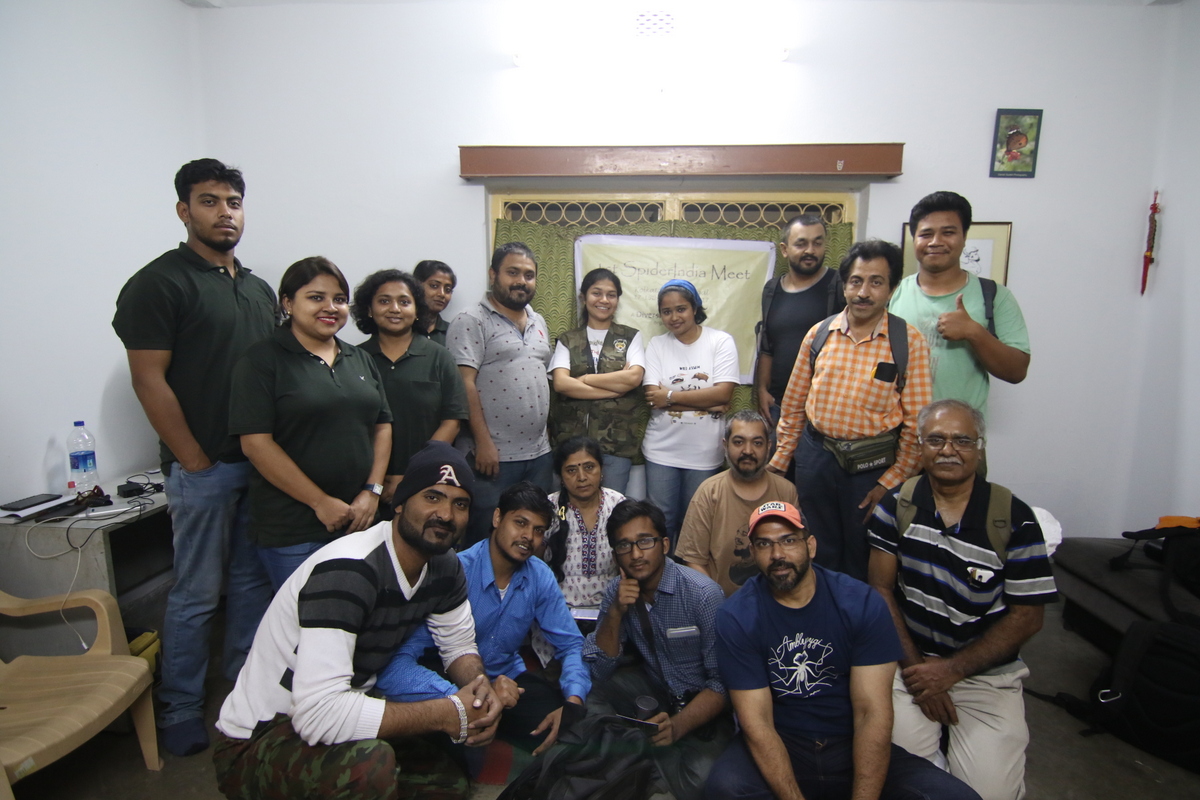
The much awaited first SpiderIndia Meet was held in Kolkata, West Bengal from the 17th – 19th February 2017.

Stay was arranged in the Oasis Guest House in Jadavpur. Enthusiastic participants from different parts of the country started coming on from the 16th night and some arrived on 17th morning. About 20 enthusiasts from 6 States attended the meet.

On the first day 17th Feb all participants assembled at the Nature Mates office at Bijoygarh. Breakfast was followed by an introduction session by the participants. From there everyone was taken to ZSI (Zoological Survey of India) where we visited the Arachnology section first, spent time interacting with the PhD students and the staff. Also got to see a lot of specimens preserved from the British Indian Empire era. This was followed by a visit to different departments in ZSI and Lunch at the canteen. 


In the afternoon we proceeded for some fieldwork in the Botanical Gardens and the day concluded at the Nature Mates office where everyone made the days checklist.

The following two days, 18th and 19th were busy with a lot of fieldwork at 3 different sites. 18th Morning was spent in Central Park also known as the Banabitan followed by lunch on field. There after we proceeded to the Eco Park where participants had the paper presentation session. An online chat with Vijay Barve and Siddharth Kulkarni currently perusing PhD at the Washington University was very rewarding. A demonstration on Spider dissection was also organized at the same site.


19th morning participants were taken to the Chintamoni Kar Bird Sanctuary for fieldwork .The session concluded in the evening at the Nature Mates office where the participants were presented with participation certificates.

Approximately 12 Families 20  Genera were photo documented and a format for future documentation of spiders was discussed. A number of interesting spiders were photographed. Anepsion sp. , Ariamnes sp. Tylorida Sp. and many more!

Three days with spider enthusiasts… researchers... was a very satisfying with a lot of knowledge exchanged and new friends made. Overall a very good experience. A big thank you to the organizing team … Vijay Barve, Arjan Basu Roy and Team Nature Mates for successfully conducting this meet .

Looking forward for the next one.

Wednesday, February 1, 2017

Rare spider spotted in a remote hospital in Assam through activities of a School Nature Club

An article was published recently in the Biodiversity Data Journal entitled, “Report of Platythomisus octomaculatus (C. L. Koch, 1845) and Platythomisus sudeepi Biswas, 1977 from India (Araneae, Thomisidae)”. The first species, P. octomaculatus, is being recorded after 120 years of its last report and its distribution has been extended to Assam in India from its previously known distributions in Java and Sumatra. The article was published by Ms. Swara Yadav, a zoologist from Satara, Maharashtra and Dr. Vijay Anand Ismavel, the Medical Superintendent of the Makunda Christian Leprosy & General Hospital (www.makunda.in) in the Karimganj District of Assam. Mr. Vinayak Patil from the College of Forestry in Dapoli, Maharashtra had also found another species in the same genus, P. sudeepi, and this observation is also discussed and reported in the same paper.
The Assam observation was possible through the activities of the “Makunda Nature Club”. Dr. Vijay Anand Ismavel had been working in the Makunda hospital (a mission hospital situated in a remote part of Assam, bordering Mizoram and Tripura) since 1993. He started photographing and documenting biodiversity in and around the campus in 2009 (shortly after suffering a heart attack). Over the next 7 years, he documented over 5300 observations (of nearly 2000 different species) – all of them uploaded to iNaturalist with over 10,000 supporting photographs - http://www.inaturalist.org/people/8853. Most of them are also posted to the different iNaturalist groups of DiversityIndia.
 In 2015, Dr. Vijay Anand founded the “Makunda Nature Club” – this is formed with some staff members (postgraduate teachers in Botany, Zoology and Biotechnology of the Makunda Christian Higher Secondary School -  a school run by the Hospital Society with over 900 children studying upto Class XII in Arts/Science) and about 30 student members. A seminar on Forest Conservation was the first activity – tree-planting and a talk by Padma Shri Jadav Payeng, the “Forest Man of India”. The club then organized a biodiversity documentation workshop conducted by Mr. Rohit George from Indian BiodiversityPortal (IBP) at Makunda and following this a “Makunda Nature Club” group was also formed on IBP to enable members to upload photos from their cellphones directly using the IBP App. Mr. Siddharth Kulkarni, an arachnologist from Pune who is also the Country Coordinator for India on the World Spider Catalog (he is presently pursuing his Ph.D in Arachnology at the George Washington University in the USA) then conducted a workshop on “Basic Arachnology” for the Club members. A few months later, Mr. Siddharth Kulkarni and Ms. Swara Yadav were  invited to Makunda to spend time with the Club members in doing a survey of spider biodiversity in the 350 acre campus of the hospital. Members learnt about spider families, habits and how to identify different species. The hospital purchased a stereo-microscope for the Club so that identification of spiders could be done in the school science laboratory. It was during this survey, that two specimens of Platythomisus octomaculatus were found (one by Antina Pasyad, a student from Class 8 of the school and the other by Rejoice Gassah, who has joined the hospital as a full-time staff of the Club – he was a student of Makunda’s School and is now pursuing his BA – both of them belong to the Jaintia tribe and their families live in jungle villages close to the hospital). One of the spiders had an egg-sac – members observed spider-lings emerge and grow over several days till they dispersed. Further scientific work on confirmation of the identification was done by Ms. Swara Yadav and Mr. Siddharth Kulkarni leading to the publication.
The Makunda Nature Club is probably the only (or one of the few) nature clubs in schools in India that inform and engage student members in actual professional scientific research in surrounding forests.  This creates an awareness of the different life forms that exist, their interdependence with each other and leads children to appreciate their beauty as well as the need to conserve forests and all the species that forests support. It also stimulates the curiosity of children and inculcates an interest to learn more about the species that are observed and adds meaning to the biology subjects that they study in class. A few children, having been exposed to observation and documentation of biodiversity may decide to pursue it as a career.
In 2015, Dr. Vijay Anand and some members of the Club found a male van Hasselt Sunbird (Leptocoma brasiliana) in surrounding forests – this species has now been found in the hospital campus as well. This was the first time this species had been photographed in present-day India and this observation was published in Indian Birds by Dr. Vijay Anand (along with Mr. Praveen Jayadevan, a researcher from Bangalore). We hope that in the years to come, more such discoveries would be made and citizen science initiatives such as the “Makunda Nature Club” would make significant contributions to existing knowledge on biodiversity.


Friday, February 14, 2014

Happy 9th Birthday SpiderIndia !

Dear Spider lovers,

Our SpiderIndia yahoo group [http://groups.yahoo.com/group/SpiderIndia/] has completed 9 years. We have matured a lot in terms of diversity over years. If you love spiders you should be on Yahoo group, because that is where we all started. Send an empty email to spiderindia-subscribe@yahoogroups.com to become member.

We are also utilizing several new avenues to learn like:


and more to come .... Always remember our reference point to all these is http://diversityindia.org  

If I have forgotten any please let me know.

We would like to reiterate the need of providing 'date and place' of each record you post on each of the above forum and the need of creating 'reusable records' on portals like iNaturalist and India Biodiversity portal rather than 'post and lost' on busy communities like FB

One of the ideas we are working on now is build a team of Curators and Admins. These are the people who want to give back to the community and are willing to put in work for the same. Curators are the people who have good identification skills, have sound technical knowledge and expertise on at least one group (e.g. Family) of spiders. These people would evolve from community and we will put in mechanism to recognize them on each of our groups. On the other hand admins are people who have some time at hand to help out the community and are willing to do some house keeping for all of us. These people would be involved in deleting spam messages, promoting our events, adding new members and reminding members to add required details . For admins no technical knowledge is required but patience with new members and politeness with all is a must. Right now we are looking for people who are willing to help with some admin tasks. To recognize Curators we will evolve the mechanism in coming months. Do let us know your views on this system we are trying to put in place.

I would like to take this opportunity to thank all the members and admins of all these groups to keep them alive and active. We always need help with newer ideas to implement, so if you are willing to help email us at vijay@diversityindia.org

If you would like to see some changes or want to implement new ideas, feel free to discuss them on the group or contact us.

Regards,

Vijay Barve
DiversityIndia
http://diversityindia.org/


Friday, December 6, 2013

Tarantulas Loved to Extinction?

6 December 2013 6:15 pm
Spiders may not be the most cuddly of species, but some are so prized by collectors that their existence could be in peril. The pet trade is one of the reasons that the U.S. Fish and Wildlife Service (FWS) this week took a step toward putting 11 species of tarantula on its list of endangered species. This slideshow highlights some of these colorful species and their natural history.
The spiders live in India and Sri Lanka, so the main impact of listing them would be to generally prohibit their importation or sale within the United States. Most of the species live in trees and are threatened by deforestation. Some will enter homes, where people kill them. All of them are threatened by collection for the pet trade. The reddish parachute spider (Poecilotheria rufilata), in particular, is difficult to breed in captivity, and requires wild individuals.
Brent Hendrixson, a spider biologist at Millsaps College in Jackson, says that habitat destruction is most likely the largest threat to the tarantulas. “It might be a stretch to say that overcollecting is driving the numbers down,” he says. “We don’t have any concrete data on exports from India or Sri Lanka in terms of wild-caught animals.” Most of the individuals in the United States have been propagated through captive breeding programs, he adds. The peacock tarantula (Poecilotheria metallica), in particular, is well suited because it is easy to breed and grows rapidly. They’re also stunningly beautiful.
In 2010, a group called WildEarth Guardians in Santa Fe petitioned FWS to list species of the genus Poecilotheria and on Tuesday, the agency agreed that there’s enough science to warrant further review. That is supposed to take a year, but often stretches out longer. FWS willaccept public comments until 3 February.

Søren Rafn
The peacock tarantula (Poecilotheria metallica) is known only from a small forest reserve in Andhra Pradesh, India. Like others in the genus, they make funnel webs inside deep crevices of old growth trees.


BayLee's 8 Legged Art
The beautiful parachute spider (Poecilotheria formosa) lives in the Eastern Ghats in southern India and is poorly known. Males have never been discovered.


BayLee's 8 Legged Art
The reddish parachute spider (Poecilotheria rufilata) ambushes prey and has been seen capturing young bats. They are smuggled from India into Europe and America for the pet trade.


Morkelsker
Found in the Kitulgala Forest Reserve of southern Sri Lanka, the fringed ornamental (Poecilotheria ornata) inflicts a painful bite. Like other tarantulas, its venom is not fatal to humans.


Brent Moore
The striated parachute spider (Poecilotheria striata) is popular among pet traders and collectors. It’s found across 2000 km2 of the Western Ghats in India, where its habitat continues to decline.


B. Smith
The wonderful parachute spider (Poecilotheria miranda) gets its name because males will sail down from trees to the ground. The population, in the Chhota Nagpur region of northeast India, is thought to be decreasing.


Laurence Livermore
The brown parachute spider (Poecilotheria subfusca) comes from south-central Sri Lanka. Scientists surveying their habitat from 2003 to 2005 found only 20 individuals.


Zoological Survey of India
The Rameshwaram parachute spider (Poecilotheria hanumavilasumica) was discovered in 2004 in a sacred grove on Rameshwaram Island in southern India. They ambush insects.

Thursday, November 21, 2013

A new species of spiders discovered in Satara

In 2010, when two researchers were busy observing migratory birds at a dam near Satara, Maharashtra, they spotted a distinct spider with a red stripe on its back. However, they just took a picture of it and left. "When we later researched this particular spider, we found out that it was called the Red-back spider. It had its origin in Australia but they were few records of it in India. We reported its existence in Satara district and this gradually got us interested in spiders," says Sidharth Kulkarni, who, along with his colleague Dr V Y Deshpande, spends much of his time at the zoology department of the Yashwantrao Chavan Institute of Satara (YCIS) studying spiders. 

 Image form Animal Discoveries 2012, ZSI

The two have now discovered a new species that belongs to the family of lynx spiders scientifically known as Oxyopidae. They have decided to name it Oxyopes Sataricus, after the Satara region.
The scientists, who are studying spider diversity in western Maharashtra, have worked together on chronicling the life stages of the Red-back spider Latrodectus hasselti, recording the scorpion-tailed spider for the first time in Maharashtra and some lynx spiders for the first time in India. "We are also hoping to study spiders as agents for controlling pests," says Deshpande. "Various spiders feed upon specific pests. Hence this research could bring out a natural and cost-free solution and possibly an alternative to chemical pesticides," says Kulkarni. 

Spiders belong to the class Arachnida and not Insecta. "The basic differentiation between these two classes is that the cephalic (head) and thoracic (thorax) region is fused in class Arachnida and called cephalothorax. Insects usually have antennae and three pairs of legs while in spiders, antennae are absent and they have four pairs of legs," says Kulkarni, adding that the ecological importance of the spiders is distinct from that of insects. 

Ref:  


Sunday, September 15, 2013

Butterflies on your mind?

Published: 15th September 2013 12:00 AM
Last Updated: 13th September 2013 11:11 AM
    Vijay Barve (Photo: Vinod Kumar T)
It was love at first sight. Vijay Barve remembers all too well, the first time he saw the pupa of a common crow butterfly. It was like a shiny gold pendant, glimmering on an oleander plant, he recalls. Before this, he had witnessed a butterfly lay eggs. And that was, probably, the moment that would direct the course of his life. The boy who had begun to observe the lifecycles of butterflies soon joined the ranks of bonafide butterfly lovers and made it his life’s mission to spread awareness about the ubiquitous, brightly winged insect.
It is hardly surprising that Vijay grew up to be a butterfly expert. Childhood comprised of weekend bird watching trips with parents who were avid nature lovers. Raised to admire and observe the natural world, Vijay’s nature education was quite thorough.
A master’s degree in computer science from Pune University, followed by a stint with a scientific and research organization FRLHT (Foundation for Revitalisation of Local Health Tradition), further cemented his closeness to nature. At FRLHT, Vijay was involved in the distribution mapping of medicinal plants. And with plants came butterflies as a particular butterfly makes its home only on a certain plant to lay eggs. Broadening his scope of interest, Vijay did a course in entomology from the Bombay Natural History Society, of which he is a life-long member.
In 2001, Vijay started the Butterfly India Yahoo group. This e-initiative gave a platform to butterfly lovers (it has 1,500 members at present) across the country to share pictures and information.
“We may have butterfly experts like Isaac Kehimkar, Krushnamegh Kunte, Peter Smetacek and many others in India, but it’s Vijay who brought us together,” says Kolkata-based butterfly specialist, Arjan Basu Roy. “If butterfly watching/photography has become a popular form of nature study in India, significant credit goes to him.” Vijay also launched DiversityIndia Yahoo group that focuses on small invertebrates.
Besides this, Vijay has also created and has been managing cyber communities of naturalists interested in different biodiversity such as SpiderIndia, DragonflyIndia, IndianMoths, AmphibianIndia, ReptileIndia, InsectIndia, InvertebrateIndia, WildflowerIndia, GernCareerIndia and GreenLifestyleIndia.
Things thus chugged along in the virtual world, until Vijay and his friends came up with the idea of butterfly meets. “It was sometime in 2004 when we had the first butterfly meet, one in Kerala at the Shendurney Wildlife Sanctuary and another in Mumbai,” says Vijay. “Meets such as these fulfill a useful purpose—of bringing like-minded people together to do some fieldwork which led to sharing and learning techniques of identification, photography,” he explains. 
A job shift saw Vijay making his way to the University of Kansas, USA, where again he was able to coalesce his interest in biodiversity with his work. One experiment that he fondly remembers is the radio tagging of laboratory-raised monarch butterflies, a pioneering effort for sure. The monarch butterfly undertakes a spectacular migration, traversing thousands of kilometres from Canada to Mexico. “With our refined tracking system, we were able to track them for 10 miles,” he says.
Butterfly conservation, says Vijay, is essential. “The butterfly is an indicator species, it is sensitive to the environment. Greater numbers of butterflies in a region signify that the ecology is in good shape,” says Vijay, who lists the Blue Mormon butterfly as his favourite.
Vijay feels the best way to create interest in butterfly conservation is through the media and by constructing butterfly parks.

Original Post

Thursday, February 14, 2013

SpiderIndia is 8


Our SpiderIndia yahoo group [http://groups.yahoo.com/group/SpiderIndia/] has completed 8 years. We all have shared and learnt a lot in these years from each other.
Spider And Bee
Spider And Bee (Photo credit: Vijay Barve)

We are also utilizing several new avenues to learn like:
Flickr Tag: http://www.flickr.com/photos/tags/Spiderindia/  Picasa Tags: https://picasaweb.google.com/lh/view?q=Spiderindia Facebook group: http://www.facebook.com/groups/SpiderIndia/ Google+ Page: https://plus.google.com/u/0/b/104688115618343243604/104688115618343243604/posts Google+ Community: https://plus.google.com/u/0/communities/104619653750903799413 iNaturalist Project: http://www.inaturalist.org/projects/spiderindia IndiaBiodiversityPortal : http://indiabiodiversity.org/biodiv/observation/list/?sGroup=829&habitat=267835&max=&tag=spiderindia DI Blog: http://diversityindia.blogspot.com/search/label/SpiderIndia DI News Blog: http://diversityindianews.blogspot.com/search/label/SpiderIndia
and more to come .... Always remember our reference point to all these is http://diversityindia.org 
If I have forgotten any please let me know.
I would like to take this opportunity to thank all the admins and members of all these groups to keep them alive and active. We always need help with newer ideas to implement, so if you are willing to help email us at vijay@diversityindia.org 
If you would like to see some changes or want to implement new ideas, feel free to discuss them on the group or contact us.


Wednesday, June 20, 2012

Spiders are 'misunderstood' and feared for their shape

Spiders are the source of fear for thousands because of the shape of their legs and their colour, scientists have claimed.

Arachnophobic driver caused car crash when spider dropped from sun visor
Professor Jon May claims people are frightened of spiders because of their angular legs and dark colours. Photo: PA
The creatures inspire a phobia because they are associated with things we expect to fear and we do not understand their behaviour, according to studies.
Professor Jon May, from Plymouth University, said colourful insects like ladybirds were seen as less scary than dark spiders with angular legs.
Their fast movements scuttling across floors into dark corners also tap into deep-rooted fears, it was claimed.
"Spiders just tick all these boxes, and like any phobia, when it builds up in someone’s mind they can become scared even seeing a picture," Professor May told the Daily Mail.
"We like bright-coloured butterflies and ladybirds, but spiders are dark coloured with long angular legs – and the shape and colour both have strong negative associations.
The creatures inspire a phobia because they are associated with things we expect to fear and we do not understand their behaviour, according to studies.

Professor Jon May, from Plymouth University, said colourful insects like ladybirds were seen as less scary than dark spiders with angular legs.

Their fast movements scuttling across floors into dark corners also tap into deep-rooted fears, it was claimed.

"Spiders just tick all these boxes, and like any phobia, when it builds up in someone’s mind they can become scared even seeing a picture," Professor May told the Daily Mail.

"We like bright-coloured butterflies and ladybirds, but spiders are dark coloured with long angular legs – and the shape and colour both have strong negative associations.

"We are also very sensitive to seeing things moving out of the corner of our eye and immediately notice it, and insects move quickly and unpredictably.
"People scared of spiders will often report them being bigger than they were or say they saw one crawl into someone’s mouth, which spiders never do. We don’t understand their behaviour."

He said fears could be dealt with by learning more about spiders and trying to sympathise with them.

Professor May and Dr Adam Hart, from the University of Gloucestershire, will be hosting a public session about why people are afraid of insects at Cheltenham Science Festival on Sunday.

Dr Hart said one way to appreciate bugs was to eat them and he will be cooking a mealworm stir fry for visitors.

Original Post

Friday, May 4, 2012

Name a Spider Contest

Published by WayneMaddison | Sat, 10/22/2011
 
Our Name a Spider contest was a resounding success.  We received 810 wonderful entries from all over Canada (and beyond).  It's exciting to see how many people want to help name a spider species!

Remember that the name of the spider would start with "Lapsias" and then end with the name suggested by our winning contestant, as in "Lapsias suggestedName".  Some of the suggested names described the spider's appearance.  A popular category was to translate "yellow mustache" into Latin or Greek.  But we also received suggestions from other languages: Sanskrit, Kichwa, Hindi, Tagalog, Spanish, and Garo.  Other names honoured people — one popular choice was to name the spider after the Vancouver Canucks hockey team or its players!

The winning name, when we saw it, jumped out as perfect for this spider species.  But before I tell you what it was, I want to mention three of our other favourite names.  First, there was the suggestion "Lapsias chamardor" from Nina Piggott, of Vancouver BC.  She explained as follows:

My 3 year old niece, Arden, came up with this name. When asked for a name for the spider, she threw her arms in the air and growled out "Chamardor!!" with a distinctive Klingon accent. A name we've never heard before!

"Chamar" is Portuguese verb for "call me " as in name me and D'or is French for "golden". So "call me golden" for the spider for the golden face..

Another one of our favourites was from Thomas C. of Vancouver, BC, who suggested "Lapsias wushu".  Here's his explanation:

The Chinese word wushu has two meanings: the first being to refer to martial arts collectively, the second to refer to a particular sport and fighting discipline that involves elegant gymnastic movements and aerial techniques.

The art of wushu is evident is such films as Crouching Tiger, Hidden Dragon. I think the name would be well chosen since jumping spiders seem to me at least to move with great elegance and their jumping prowess is of course obvious. Furthermore, they are predatory spiders (but with finesse!) and as such their name should capture that.

Our third favourite-but-not-winner was "Lapsias xencofogus" from Dylan Jeffery Leung of William Van Horne Elementary School in Vancouver:

It should be called Lapsias xencofogus because there is no spider with a name that starts with X and I need to finish my Spider Alphabet Book.

We loved his explanation, but more that that, the name "xencofogus" is a beautiful sounding name.  And, actually, there are spiders whose names begin with "X".  One jumping spider from Fiji is called Xenocytaea; other from the Middle East and Africa is called Xuriella.  (Dylan, put those in your book!)

Finally, we come to the winner (drum roll please!):  Lapsias lorax, from Tristan Long of Waterloo, Ontario. 

picture of the  jumping spider Dr. Maddison discovered

Tristan explains: The yellow stripes on the spider remind me of the mustache of the Lorax character from the eponymous book by Dr. Seuss. As the book recounts the dangers to biodiversity of overdevelopment, I think that the name is very suitable.

The Lorax's message to preserve biodiversity, and his resemblance to the new spider, make his the perfect name for the new spider.  If Lorax had been his proper name, we would likely have used the form Lapsias loraxi (or, and I'm guessing here, Lapsias loraci), but the character is not Lorax, but rather The Lorax.  The fact that it's not his proper name gives us some freedom to use the world "lorax" directly.

And so, Lapsias lorax will be this spider, and it will speak for the trees.  Thank you, Tristan, and thank you to the other 809 of you!

Original Story

Monday, February 27, 2012

Fear of spiders makes you believe creepy crawlies are bigger

The more you fear a spider the bigger it will appear to be, according to new research.

A portrait of a jumping spider by Dusan Beno
A jumping spider Photo: BARCROFT/DUSAN BENO
A study of arachnophobes found the worse their condition the larger they estimated the creepy crawlie's size.
The irrational fear of spiders is believed to affect as many as half of women and girls, and up to one in six males.
And the latest findings explain why many sufferers hold out their arms shrieking "it was that big" when the reality of the situation turns out to be much less scary.
A better grasp of how a phobia affects perception of feared objects can help doctors design more effective remedies, the Journal of Anxiety Disorders reports.
Psychologist Professor Michael Vasey, of Ohio State University, said: "If one is afraid of spiders, and by virtue of being afraid of spiders one tends to perceive spiders as bigger than they really are, that may feed the fear, foster that fear, and make it difficult to overcome."
His team recruited 57 participants with a spider phobia who were asked to undergo five encounters with live tarantulas in uncovered glass tanks and then provide size estimates.
The more afraid they rated in anxiety scores the bigger they described the hairy beasts, which spanned between one and six inches.
Prof Vasey said: "When it comes to phobias, it is all about avoidance as a primary means of keeping oneself safe.
"As long as you avoid, you cannot discover you are wrong. And you are stuck.
"So to the extent that perceiving spiders as bigger than they really are fosters fear and avoidance, it then potentially is part of this cycle that feeds the phobia that leads to its persistence.
"We are trying to understand why phobias persist so we can better target treatments to change those reasons they persist."
The volunteers, who were studied over a period of eight weeks, began their encounters 12 feet from the tank and were asked to approach the spider.
Once they were standing next to it, they had to guide the spider around by touching it with an 8-inch probe, and then with a shorter one.
Throughout their ordeal they reported how afraid they were feeling on a scale of 0-100 according to an index of subjective units of distress.
Afterwards they completed additional self-report measures of their specific fear of spiders, any panic symptoms they experienced and thoughts about fear reduction and future spider encounters.
Finally, they estimated the size of the spiders - while no longer being able to see them - by drawing a single line on an index card indicating the length between the tips of its front and back legs.
Prof Vasey said: "It would appear fear is driving or altering the perception of the feared object, in this case a spider.
"We already knew fear and anxiety alter thoughts about the feared thing. For example, the feared outcome is interpreted as being more likely than it really is.
"But this study shows even perception is altered by fear. In this case, the feared spider is seen as being bigger. And that may serve as a maintaining factor for the fear."
The approach tasks with the spiders are a classic example of exposure therapy, a common treatment for people with phobias.
Although this therapy is known to be effective, scientists still do not fully understand why it works.
And for some, the effects do not last - but it is difficult to predict who will have a relapse of fear, said Prof Vasey.
He and colleagues are studying these biased perceptions as well as attitudes with hopes that the new knowledge will enhance treatment for people with various phobias.
The work suggests that fear not only alters one's perception of the feared thing, but also can influence a person's automatic attitude toward an object.
Those who have developed an automatic negative attitude toward a feared object might have a harder time overcoming their fear.
Although individuals with arachnophobia are unlikely to seek treatment, the use of spiders in this research was a convenient way to study the complex effects of fear on visual perception and how those effects might cause fear to persist, Prof Vasey noted.
He added: "Ultimately, we are interested in identifying predictors of relapse so we can better measure when a person is done with treatment."

Tuesday, May 3, 2011

World’s largest fossilized spider


Yes, Paul Selden says, it’s the biggest spider fossil on record, one whose leg span stretches to be almost 6 inches.
But that’s not really the most exciting part of the Nephila jurassica spider, said the distinguished professor from Kansas University who is an expert in fossilized spiders.

A fossilized Nephila jurassica, found in the Inner Mongolia region of China. Its leg span is nearly six inches long. Paul Selden, a Kansas University distinguished professor, described the find in the journal Biology Letters.

Selden and his team, whose research was published in Biology Letters, linked the spider that walked around 165 million years ago to several similar spiders that still roam the earth.

The find — likely because of its size — attracted quite a bit of national and international press coverage.
“The size is not that big a thing,” Selden said, noting that several spiders that big — and even bigger — are still around. “We can place it right into a modern genus with these modern orb-weavers.”
These kinds of finds can take awhile before scientists understand what they’re looking at, Selden said. This particular spider fossil came to him in 2005 from a friend who had collected some specimens in the Inner Mongolia region of China. That usually entails purchasing them from farmers in the region, Selden said.

Full Story

On NGC