Jennifer S. Holland
Part of our weekly "In Focus" series—stepping back, looking closer.
Bees are back in the news this spring, if not back in fields pollinating this summer's crops. The European Union (EU) has announced that it will ban, for two years, the use of neonicotinoids, the much-maligned pesticide group often fingered in honeybee declines. The U.S. hasn't followed suit, though this year a group of beekeepers and environmental and consumer groups sued the EPA for not doing enough to protect bees from the pesticide onslaught.
For the last several years scientists have fretted over the future of bees, and although research has shed much light on the crisis, those in the bee business—from hive keepers to commercial farmers—say the insects remain in deep trouble as their colonies continue to struggle.
The current crisis arose during the fall of 2006 as beekeepers around the country reported massive losses—more than a third of hives on average and up to 90 percent in some cases. Bees were flying away and simply not coming back; keepers would find boxes empty of adult bees except for a live queen. No bee corpses remained to tell the tale. The losses were unprecedented and fast.
Now it's five years later, and though
colony collapse disorder (CCD)—the name given to the mysterious killer condition—has dwindled in the manner of cyclical diseases, bees are still battling for their lives and their colonies are weaker than ever. The
latest data, from the 2012-2013 winter, indicate an average loss of 45.1 percent of hives across all U.S. beekeepers, up 78.2 percent from the previous winter, and a total loss of 31.1 percent of commercial hives, on par with the last six years. (Most keepers now consider a 15 percent loss "acceptable.")
Unprecedented Pollinator Crisis
Why keep worrying over the fate of a bunch of pesky stinging insects? Bees in their crucial role as pollinators are paramount. Western nations rely heavily on managed honeybees—the "moveable force" of bees that ride in trucks from farm to farm—to keep commercial agriculture productive. About a third of our foods (some 100 key crops) rely on these insects, including apples, nuts, all the favorite summer fruits (like blueberries and strawberries), alfalfa (which cows eat), and guar bean (used in all kinds of products). In total, bees contribute more than $15 billion to U.S. crop production, hardly small potatoes.
No, we wouldn't starve without their services—much of the world lives without managed pollinators. But we'd lose an awful lot of good, healthy food, from cherries and broccoli to onions and almonds. Or we'd pay exorbitant costs for farmers to use some other, less efficient pollination technique to supplement the work that healthy natural pollinators could do. Plus, bee health can tell us a lot about environmental health, and thus about our own well-being.

A man uses smoke to harvest honey from a honeycomb.
Photograph by Tim Laman, National Geographic
Today's pollinator crisis, which has also hit Europe and now parts of Asia, is unprecedented. But honeybees have done disappearing acts on and off for more than a century, possibly since humans began domesticating them
4,500 years ago in Egypt. In the United States, unexplained colony declines in the 1880s, the 1920s, and the 1960s baffled farmers, and in 1995-1996 Pennsylvania keepers lost more than half of their colonies without a clear cause. The 1980s and 1990s saw various new parasites that hit bees hard; Varroa and tracheal mites became major killers, and they continue to plague hives and keep beekeepers up at night.
When CCD appeared, the USDA's Agricultural Research Service and the National Institute of Food and Agriculture joined forces to study and fight the assailant, but a half-dozen years later they still lack a smoking gun. Recent work reveals higher loads of pathogens in the guts of bees from collapsed colonies versus healthy ones—making viral infections a likely culprit.
But this isn't a case of one cause, one effect. Bee expert
Dennis vanEngelsdorpof the University of Maryland likens the situation to HIV/AIDS in humans. "You don't die of AIDS; you die of pneumonia or some other condition that hits when your immunity is down," he says. Today's bee mortalities may be behaving slightly differently. "But we're pretty sure in all these cases, diseases are the tipping point" after bees' immune systems are compromised.
So what makes bees vulnerable to those diseases, what's killing their immunity, continues to be the $15-billion question.
Problems Piling Up
Zac Browning is a fourth-generation beekeeper based in North Dakota. His mostly migratory commercial operation runs about 22,000 hives in three states—meaning he trucks his bees to different locations at different times of year, renting out their pollination services to big farms like those producing almonds in California and canola in Idaho.
CCD devastated his hives a few years back, but "we've seen losses more recently from everything imaginable," he says. "Pests, parasites, pesticide exposure, starvation, queen failures, you name it."
In addition to these problems piling up, "our inputs have gone up one-and-a-half times in the last decade," he says. "We now have to try to sustain bees [with extra food] when natural food is scarce, dearth periods that didn't exist before."
Part of the problem is keepers have to boost hive numbers to meet demand, "but the carrying capacity of the environment hasn't changed." In fact, it's gone down. The amount of undeveloped land with good bee forage just isn't enough to sustain the masses, he says.
Meanwhile, studies have shown that colonies with access to the best pollens (with more than 25 percent protein plus essential amino acids), which occur in diverse plant habitats once common across the landscape, are more robust and more resistant to disease than those in pollen-poor environments.
The Threat From Pesticides
Another adversary in the bees' battle, as the EU reminds us, is pesticides. Pesticides themselves aren't necessarily a death sentence for bees—and debate rages over whether, when properly applied, these chemicals can be used safely among pollinators. But exposure to them seems to open the door to other killers.
For example, bees exposed to sublethal doses of neonicotinoids—the type the EU is banning and that are used routinely in the U.S. on wheat, corn, soy, and cotton crops—become more easily infected by the gut parasite
Nosema.
Meanwhile, last year a French study indicated that this same class of chemicals can fog honeybee brains and alter behavior. And a British study on bumblebees, a natural pollinator in decline in many places, reported neonicotinoids keep bees from supplying their hives with enough food for queen production.

A man shows his hive's queen bee.
Photograph by Marcio Jose Sanchez, AP
"Honeybees are complex," says Browning. "If you reduce their lives by even just a few days, the colony itself never thrives, never reaches its maximum potential. Sublethal effects that don't kill adults outright may still render hives weak and lethargic. And those hives might not survive the winter."
What takes down the individual bee doesn't necessarily wipe out the colony, vanEngelsdorp explains. And pesticides, like other factors, do their worst when combined with other chemicals or stressors, not necessarily all by themselves. "It's synergism," he says. "One plus one may equal 10 with the right two products or insults together." (Samples of bee-collected pollen typically contain residue from numerous pesticides.) In the end, then, an immune-suppressed colony faces a downward spiral, unable to cope with stressors that weren't a problem during healthier years.
The chemicals of modern agriculture have long been vilified, and they certainly represent a vital and active line of inquiry: The number registered for use in the U.S. exceeds 1,200 active ingredients distributed among some 18,000 products, and state pesticide use records are mostly unavailable, leaving a lot of question marks. No one knows much about how low-level exposure to various chemicals over time or how various combinations affect the insects. Meanwhile, migratory colonies likely have very different chemical exposure than those who stay put. The landscape is messy.
A New Concern
In newly worrisome findings,
a study from a team at Penn State has revealed that "inert" ingredients (adjuvants) used regularly to boost the effectiveness of pesticides do as much or more harm than the active "toxic" ingredients. In one study adjuvants were shown to impair adult bees' smelling and navigation abilities, and in a separate study they killed bee larvae outright.
The formulas for these other ingredients "are often proprietary information and not disclosed by the companies," says Penn State's
Maryann Frazier, who wasn't an author on the study, "so they cannot be independently tested and assessed for toxicity. When [the] EPA screens pesticides for registration, they only consider the active ingredient," she says.
In addition, "there are no requirements by [the] EPA for companies to test the impacts of pesticides on immature stages of pollinators," she says, "only adults."
The EPA participated in a stakeholder conference last year to discuss honeybee health (
a report is just out from that event). An EPA spokesperson declined to comment on the pending lawsuit but noted that the agency has been working to speed up its review of research related to neonicotinoids and their effect on honeybees. It is also tweaking existing regulatory practices to address various concerns including pesticide dust drift, product label warnings, and enforcement of bee-kill investigations.
Barrage of Stressors
So in addition to a changing climate and bizarre local weather systems, bees are threatened by chemical exposure in untested and unregulated combinations, disappearing foraging habitat with increasing monoculture that requires trucking bees from place to place, and fungal and viral intruders, plus the dreaded Varroa mite.
Meanwhile, nature is not sitting still. The diseases that are taking out immune-suppressed bees are quick to evolve resistance to farmers' attempts to protect their bees. "Based on our management surveys last year, not one commercial product against Varroa worked consistently," says vanEngelsdorp, citing numerous examples.
With the barrage of stressors bees face, perhaps we shouldn't be surprised that they're no longer as resilient as they once were. And honeybees, vanEngelsdorp points out, are among the most robust pollinators. The native insects, such as bumblebees, stingless bees, and flies, may be in worse shape, though their plights—and role in the ecosystem—are far less well known.
Meanwhile, the lawsuit against the EPA is just revving up (the first hearing was March 15), and scientists continue to push hard to get more information on the unregulated ingredients in agrochemicals that are proving harmful. "Unless we can get at what's actually being used on fields, we can't analyze their effects," says toxicologist
Chris Mullin, a co-author of the Penn State adjuvant study. And some products, he says, "are nearly 100 percent adjuvant. Illogically, they are considered safe until proven otherwise."
Other voices have risen strongly against current land use practices. "Honeybees need habitat," Browning says. "That's any floral source with good nutrition. And that's not wheat, corn, or soy, crops that take up well over 60 percent of U.S. farmland." We've traded bee needs for biofuel, he laments, and we're paying the price.
"We also need good cooperation from [the] EPA—and from farmers and pesticide applicators—to implement and enforce best management practices," he says. Also on his wish list: a better battery of tools to effectively combat the Varroa mite, the bane of all beekeepers.
"Bee culture has adapted to fit monoculture, and that's not healthy," says Browning. "If we can instead invest in good sustainable practices in agriculture, we can still thrive."
But his confidence in the future, along with that of many of his fellow beekeepers, is declining with his hives. "We're just about tapped out," he says. "Without some real action we'll see this industry dwindle away." And as the industry goes, so go the little yellow insects that put so much good food on our plates.
Jennifer S. Holland, a contributing writer to National Geographic
, wrote aboutpollinators in the March 2011 issue of National Geographic
.
 When Geetha Iyer looks out into her expansive garden in her home in Suchindram, near Kanyakumari, or any garden or patch anywhere, for that matter, it’s not only the trees, flowers, birds, bees and butterflies that she sees but also wasps, moths, crickets, spiders and hundreds of other insects that live hidden in plain sight. It’s only a matter of opening your eyes and you can see the sheer diversity in the insect world, feels Geetha, author of the book The Weavers - The Curious World of Insects, published by Harper Collins.


 A small brown moth has one of the most complex sex lives in the insect world, new research has found.


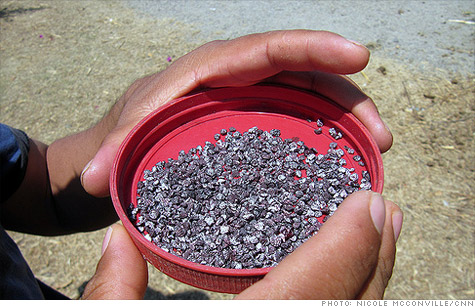 Crushed cochineal extract has been used as a red dye for centuries, but it won't be used for much longer by Starbucks.