The HinduA file photo of a whale shark being slaughtered by fishermen at Kumbhabhishekam in Kakinada. — Photo: By Special Arrangement
Monday, June 23, 2014
Slaughter of whale sharks on the rise
Sunday, December 8, 2013
Sri Lanka on world map of biodiversity hotspots
Central highlands complex is a world Heritage Site designated in 2010 and consists of three main protected areas – the Peak Wilderness Protected Area, the Horton Plains National Park and the Knuckles Conservation Forest.These forests include the largest and least disturbed remaining areas of the submontane and montane rain forests of Sri Lanka and these protected areas cover an area of 537 square kilometers. More than half of the country’s endemic vertebrates, half of the country’s endemic flowering plants are found in these forests and grassland ecosystems.However, these protected areas are threatened with anthropogenic causes. For instance, the Knuckles area is highly threatened with cardamom cultivation and the Peak Wilderness is threatened with encroachments.
This research or its relevancy to Sri Lanka was not much highlighted in Sri Lankan media. This issue should be taken in to consideration of conservation authorities, when designing conservation strategies and action as the importance of these protected areas has been defined scientifically.
Tuesday, May 24, 2011
Countries adopt pledge to protect elephants
NIRMALA GEORGE
Friday, September 10, 2010
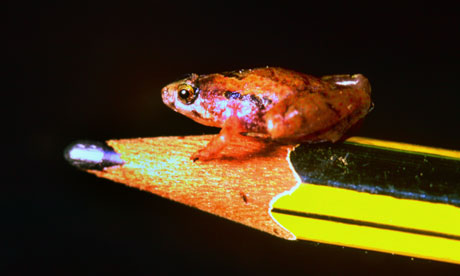
Pea sized frog found on Borneo island
The frog species Microhyla nepenthicola, discovered in Borneo. Photograph: Indraneil Das/AFP/Getty ImagesAdult males of the new micro-species range in size from 10.6 and 12.8 millimetres and the pea-sized amphibian has been named Microhyla nepenthicola after the plant on Borneo on which it lives, according to taxonomy magazine Zootaxa.
Dr Indraneil Das of the Institute of Biodiversity and Environmental Conservation at the Universiti Malaysia Sarawak said the sub-species had originally been mis-identified in museums.
"Scientists presumably thought they were juveniles of other species, but it turns out they are adults of this newly-discovered micro species," he said.
Das published the paper with Alexander Haas of the Biozentrum Grindel und Zoologisches Museum of Hamburg, Germany.
The mini frogs were found on the edge of a road leading to the summit of the Gunung Serapi mountain in the Kubah National Park in the Malaysian state of Sarawak.
The scientists said they tracked the frogs by their call, a series of "harsh rasping notes" that started at sundown.
They then made the frogs jump onto a piece of white cloth to study them.
The find was part of a global search being undertaken by Conservation International and International Union for Conservation of Nature's Amphibian Specialist Group to "rediscover" 100 species of lost amphibians (www.conservation.org/lostfrogs).
(Reporting by David Chance; Editing by Sanjeev Miglani)
© Thomson Reuters 2010 All rights reserved
Link to news on Reuters
Tuesday, April 6, 2010
Ayurveda out of balance: 93 percent of medicinal plants threatened with extinction

The survey used criteria and categories established by the International Union for Conservation of Nature (IUCN) for its Red List of Threatened Species.
Image: Dhanvantari, the Hindu god of Ayurveda, via Wikipedia
Sunday, April 4, 2010
93% of wild medicinal plants in endangered list: Study
Thursday, March 25, 2010
Pictures: 7 Cat Species Found in 1 Forest—A Record

Leopard Spotted
Released in February, the picture was taken during a two-year survey supported by the Critical Ecosystem Partnership Fund, the Ashoka Trust for Research in Ecology and the Environment, the Rufford Small Grants Foundation, and the Wildlife Conservation Society.
The research found seven cat species in a 354-square-mile (570-square-kilometer) range—the highest diversity of cat species yet photographed in a single area.
Wildlife biologist Kashmira Kakati had been studying the gibbons of Jeypore-Dehing and became curious about the predator tracks she kept finding on the ground.
"I said, I need to find out what's there," Kakati told National Geographic News. "Nobody had any clue. People who had been in the forest 30 years didn't know."
With 30 digital camera traps, Kakati captured not only the cats but a number of other rare forest animals between 2007 and 2009. "Even I was surprised by the result," she said. (See related pictures of a rare Chinese wildcat snapped by a camera trap.)
(Related: National Geographic's Big Cats Initiative.)

Cloudy Coat
The clouded leopard is listed as vulnerable by the International Union for Conservation of Nature, which means the species faces a high risk of extinction. The cat's population is on the decline, mostly due to loss of habitat from deforestation. (See a picture of rare clouded leopard cubs born at a Virginia zoo.)
In Jeypore-Dehing, the cat is so seldom seen that local villagers don't even have a name for it, Kakati said.

Little Leopard
The species is commonly recorded across its range in Asia, according to the International Union for Conservation of Nature. Leopard cats are considered to have generally stable populations, except for a few subspecies that are close to extinction.

Golden Moment
In addition to the seven cat species, Kakati's camera traps recorded 12 other carnivore species in the Jeypore-Dehing range, including a dhole, or Asiatic wild dog; the Malayan sun bear; and several species of the catlike mammal the civet.

Jungle Cat
In addition, some animals—including the jungle cat pictured above—appear to be migrating to Jeypore-Dehing from adjoining forests to escape severe poaching, Kakati said.
"The range has become a refuge," she said. "Somehow the animals have managed to hold on."

Rear March
Although many cat species are at risk due to poaching for their bones and pelts, people in Jeypore-Dehing don't hunt the cats themselves, Kakati said. But locals do poach the wild deer and pigs, cutting in on carnivores' food sources.

Spotty Protection
"The entire forest here should be protected as a single conservation landscape, free of disturbance and connected by wildlife corridors between the disjunct sections," Ravi Chellam, of the Wildlife Conservation Society's India Program, said in a statement.
—Dan Morrison
Story
National Geographic Daily News
Monday, March 22, 2010
Butterflies, beetles, and dragonflies declining in Europe
Habitat loss is having a serious impact on Europe's butterflies, beetles and dragonflies, the International Union for the Conservation of Nature (IUCN) said today.
Nine percent of butterflies, 11 percent of saproxylic beetles (beetles that depend on decaying wood) and 14 percent of dragonflies are threatened with extinction within Europe, the Switzerland-based conservation organization said in a news release.
Photo of beautiful demoiselle (Calopteryx virgo meridionalis) by Jean-Pierre Boudot
"Some species are so threatened that they are at risk of global extinction and are now included in the latest update of the IUCN Red List of Threatened Species," IUCN said.
"When talking about threatened species, people tend to think of larger, more charismatic creatures such as pandas or tigers, but we mustn't forget that the small species on our planet are just as important, and are also in need of conservation action," said Jane Smart, Director, IUCN Biodiversity Conservation Group. "Butterflies, for instance, play a hugely pivotal role as pollinators in the ecosystems in which they live."
Nickerl's fritillary (Melitaea aurelia)
Photo by Chris van Swaay, De Vlinderstichting/Dutch Butterfly Conservation
According to the new studies commissioned by the European Commission and carried out by IUCN, Butterfly Conservation Europe and the European Invertebrates Survey, nearly a third (31 percent) of Europe's 435 butterfly species have declining populations and nine percent are already threatened with extinction.
"For example, the Madeiran large white butterfly (Pieris wollastoni) is Critically Endangered (possibly extinct), having not been seen on Madeira for at least 20 years, and the Macedonian grayling butterfly (Pseudochazara cingovskii) in the Former Yugoslav Republic of Macedonia is also Critically Endangered because quarrying activities are reducing its habitat," IUCN said.
Coenonympha orientalis
Photo by Neil Thompson
A third of Europe's butterflies (142 species) are found nowhere else in the world, and 22 of these endemic species (15 percent) are globally threatened.
"Most butterflies at risk are confined to southern Europe; their main threat is habitat loss, most often caused by changes in agricultural practices, either through intensification or abandonment, or to climate change, forest fires and the expansion of tourism,"' said Annabelle Cuttelod, IUCN Coordinator of the European Red List.
For the first time, saproxylic beetles have been assessed for the IUCN Red List.
Cucujus cinnaberinus
Photo by Nicolas Gouix and Hervé Brustel
"These beetles are unique because they are highly dependent on decaying wood, particularly in forests, and play an essential role in recycling nutrients," IUCN said.
"A third of the 431 species assessed are unique to Europe. Almost 11 percent (46 species) are at risk of being lost from the region, and seven percent (29 species) are threatened with extinction at the global level. A further 13 percent (56 species) are listed as Near Threatened within Europe."
The main long-term threats to saproxylic beetles are habitat loss due to logging and the decline in the number of mature trees.
The violet click beetle (Limoniscus violaceous) is an Endangered species that typically lives in large tree cavities containing wood mould. It is under threat from changing woodland management practices, IUCN said.
Dragonflies occur almost everywhere in Europe, with the highest numbers in southern France, the foothills of the Alps and parts of the Balkan Peninsula, accfording to the IUCN study.
Black percher (Diplacodes lefebvrii)
Photo by Jean-Pierre Boudot
"Fourteen percent of the 130 dragonfly species assessed are at risk; five of these are threatened with global extinction. A further 11 percent are considered Near Threatened within Europe.
"Like butterflies, most of the threatened species are confined to southern parts of Europe. Increasingly hot and dry summers combined with intensified water extraction for drinking and irrigation are causing the dragonflies' wetland habitats to dry up."
Three of the most threatened dragonflies of Europe are endemic to the brooks and small rivers of Greece and nearby countries, including Albania, Bulgaria and Turkey. If no action is taken species like the Greek red damsel may become extinct during the first half of this century, IUCN said.
"Nature's future is our future, and if it fails, we will fail too," said EU Environment Commissioner Janez Potočnik. "The ecosystem services nature provides, like the provision of food and water and climate regulation, are the vital backbone of our future prosperity. So when a Red List like this raises the alarm, the implications for our own future are clear. This is a worrying decline."
Tuesday, January 19, 2010
Biodiversity Loss Is 'Wake-Up Call', Warns UN
by Richard Black
The UN launches the International Year of Biodiversity on Monday, warning that the ongoing loss of species affects human well-being around the world.
The rate of species loss leads some biologists to say that we are in the middle of the Earth's sixth great extinction, the previous five stemming from natural events such as asteroid impacts. (photo by flickr user _PaulS_)The expansion of human cities, farming and infrastructure is the main reason.
Dignitaries including German premier Angela Merkel will speak at the launch in Berlin, with a video message from UN Secretary-General Ban Ki-moon.
Mr Ban is due to say that human expansion is wiping out species at about 1,000 times the "natural" or "background" rate, and that "business as usual is not an option".
The Secretary-General is expected to argue that the failure to protect biodiversity "should be a wake-up call", leading to effective ways of protecting forests, watersheds, coral reefs and other ecosystems.
The UN says that as natural systems such as forests and wetlands disappear, humanity loses the services they currently provide for free, such as the purification of air and water, protection from extreme weather events and the provision of materials for shelter and fire.
The rate of species loss leads some biologists to say that we are in the middle of the Earth's sixth great extinction, the previous five stemming from natural events such as asteroid impacts.
Cash log
The UN Convention on Biological Diversity (CBD) was agreed at the Rio Earth Summit of 1992, alongside the climate change convention.
But it acquired its key global pledge during the Johannesburg summit of 2002, when governments agreed to achieve a "significant reduction" in the rate of biological diversity loss by 2010.
Conservation organisations acknowledge that despite some regional successes, the target is not going to be met; some analyses suggest that nature loss is accelerating rather than decelerating.
"We are facing an extinction crisis," said Jane Smart, director of the biodiversity conservation group with the International Union for the Conservation of Nature (IUCN).
"The loss of this beautiful and complex natural diversity that underpins all life on the planet is a serious threat to humankind now and in the future."
A large on-going UN-sponsored study into the economics of biodiversity suggests that deforestation alone costs the global economy $2-5 trillion each year.
In his speech at Monday's event, United Nations Environment Programme (UNEP) executive director Achim Steiner is due to highlight problems caused by invasive species, and the potential for ecosystems such as forests and wetlands to absorb and store carbon from the air.
The UN hopes some kind of legally-binding treaty to curb biodiversity loss can be agreed at the CBD summit, held in Japan in October.
One element is due to be a long-awaited protocol under which the genetic resources of financially-poor but biodiversity-rich nations can be exploited in a way that brings benefits to all.
However, given the lack of appetite for legally-binding environmental agreements that key countries displayed at last month's climate summit in Copenhagen, it is unclear just what kind of deal might materialise on biodiversity.
Political football
The UN has been pursuing new ways of raising public awareness on the issue, including a collaboration with the Cameroon football team taking part in the African Nations Cup finals.
Many environment organisations will be running special programmes and mounting events during the year.
"The big opportunity during the International Year of Biodiversity is for governments to do for biodiversity what they failed to do for climate change in Copenhagen," said Simon Stuart, a senior science advisor to Conservation International and chair of IUCN's Species Survival Commission.
"They have the chance to make a major difference; and key to this will be halting species extinctions, the most irreversible aspect of biodiversity loss."
WWF is highlighting 10 species it considers especially threatened, ranging from commercially significant ones such as bluefin tuna to the Pacific walrus and the monarch butterfly.
In the UK, the national IYB partnership - hosted from the Natural History Museum (NHM) - is asking every citizen to "do one thing for biodiversity" in 2010.
Monday, January 11, 2010
World's biodiversity 'crisis' needs action, says UN
Environment correspondent, BBC News website
The UN has launched the International Year of Biodiversity, warning that the ongoing loss of species around the world is affecting human well-being.
Eight years ago, governments pledged to reduce the rate of biodiversity loss by 2010, but the pledge will not be met.
The expansion of human cities, farming and infrastructure is the main reason.
Speaking at the launch in Berlin, German premier Angela Merkel urged the establishment of a new panel to collate scientific findings on the issue.
Achim Steiner, executive director of the UN Environment Programme (UNEP), urged governments and their leaders to renew their commitment to curbing biodiversity loss even though the 2010 goal will be missed.
| Simon Stuart Conservation International/IUCN |
"The urgency of the situation demands that as a global community we not only reverse the rate of loss, but that we stop the loss altogether and begin restoring the ecological infrastructure that has been damaged and degraded over the previous century or so," he said.
The UN says that as natural systems such as forests and wetlands disappear, humanity loses the services they currently provide for free.
These include purification of air and water, protection from extreme weather events, and the provision of materials for shelter and fire.
With species extinctions running at about 1,000 times the "natural" or "background" rate, some biologists contend that we are in the middle of the Earth's sixth great extinction - the previous five stemming from natural events such as asteroid impacts.
Cash log
The UN Convention on Biological Diversity (CBD) was agreed at the Rio Earth Summit of 1992, alongside the climate change convention.
| FROM BBC WORLD SERVICE |
But it acquired its key global pledge during the Johannesburg summit of 2002, when governments agreed to achieve a "significant reduction" in the rate of biological diversity loss by 2010.
Conservation organisations acknowledge that despite some regional successes, the target is not going to be met; some analyses suggest that nature loss is accelerating rather than decelerating.
"We are facing an extinction crisis," said Jane Smart, director of the biodiversity conservation group with the International Union for the Conservation of Nature (IUCN).
"The loss of this beautiful and complex natural diversity that underpins all life on the planet is a serious threat to humankind now and in the future."
Mrs Merkel backed the idea of forming a scientific panel to collate and assess research on biodiversity loss, as the Intergovernmental Panel on Climate Change (IPCC) assesses evidence on climatic indicators.
"The question of preserving biological diversity is on the same scale as climate protection," she said.
"It would be sensible to have an interface between the politics and the science to integrate knowledge."
|
A large on-going UN-sponsored study into the economics of biodiversity suggests that deforestation alone costs the global economy $2-5 trillion each year.
The UN hopes some kind of legally-binding treaty to curb biodiversity loss can be agreed at the CBD summit, held in Japan in October.
One element is due to be a long-awaited protocol under which the genetic resources of financially-poor but biodiversity-rich nations can be exploited in a way that brings benefits to all.
However, given the lack of appetite for legally-binding environmental agreements that key countries displayed at last month's climate summit in Copenhagen, it is unclear just what kind of deal might materialise on biodiversity.
Political football
The UN has been pursuing new ways of raising public awareness on the issue, including a collaboration with the Cameroon football team taking part in the African Nations Cup finals.
Many environment organisations will be running special programmes and mounting events during the year.
"The big opportunity during the International Year of Biodiversity is for governments to do for biodiversity what they failed to do for climate change in Copenhagen," said Simon Stuart, a senior science advisor to Conservation International and chair of IUCN's Species Survival Commission.
"They have the chance to make a major difference; and key to this will be halting species extinctions, the most irreversible aspect of biodiversity loss."
WWF is highlighting 10 species it considers especially threatened, ranging from commercially significant ones such as bluefin tuna to the Pacific walrus and the monarch butterfly.
In the UK, the national IYB partnership - hosted from the Natural History Museum (NHM) - is asking every citizen to "do one thing for biodiversity" in 2010.

Wednesday, December 23, 2009
Creating Conservation Communities
By Elizabeth Hightower
![]() | ||
![]() | Courtesy of Mark Godfrey/The Nature Conservancy | ![]() |
![]() | ![]() | |
IN MAY AND JUNE 2004, scientists from the Nature Conservancy ran a Rapid Ecological Assessment of the Solomon Islands. For 35 days, they cruised 2,000 miles down the 950-island archipelago in their liveaboard dive ship, counting spinner dolphins and clownfish, Maori wrasses and beaked whales. The place was an astonishing hot spot of biodiversity, teeming with 494 coral species and at least 1,019 species of reef fish, including several previously unknown to science.
The scientists also found significant evidence of overfishing, confirmation that these waters needed protection—and fast. But what they did next reflects an ongoing shift in conservation philosophy. Instead of just setting up a marine park to keep local fishermen out, the Nature Conservancy and its partners engaged the islands' tribal leaders, allowing them to manage the fishery for their own long-term economic interests. The conservationists scrapped pristine nature as the goal and put people first; the people, in turn, found a way to both create a protected area and keep fishing. Sea turtle numbers have almost tripled. And livelihoods have doubled.
| The rest of the world is not made up of "affluent white people who enjoy nature hikes," says Nature Conservancy scientist Peter Kareiva. Conservation today means meeting everybody's needs. |
"Too much conservation is about sequestering nature," TNC's chief scientist, Peter Kareiva, says. Environmentalists have always worked with local people, he points out; that's not new. "The difference is that now we're being more explicit about it. Instead of collecting data to see how the birds and trees are doing, we do household surveys to see, if we set up a marine protected area, whether the people in those communities feel better off. That's a down-to-earth, concrete change."
People? Really? Since John Muir first walked the Sierra, hasn't the point of conservation been to protect nature from people?
Not anymore. In a slow but dramatic shift, the world's biggest environmental NGOs—the Nature Conservancy, the World Wildlife Fund, and Conservation International—have retooled their goals. Saving chunks of nature by fencing people out is too piecemeal, too arrogant, they've come to believe. What's more, it doesn't work on the scale we need.
"The historic approach will fail," says Peter Seligmann, Conservation International's co-founder and CEO. If we don't rethink our tactics, he believes, "we will have islands in a sea of development, and islands are always eventually eroded."
That's a strong statement coming from Mr. Biodiversity himself. CI invented the term "hot spots"; since its founding, in 1987, when Seligmann and others peeled off from the Nature Conservancy, the group has championed the preservation of wild places above all else. But over the past two years, CI has embarked on a painful journey of consultant-aided soul searching. This fall, it announced a new mission: "to empower societies to responsibly and sustainably care for nature for the well-being of humanity."
In some ways, CI can afford this kind of drama; it's the only big conservation NGO not beholden to public members. But the turnaround required some harsh reexamination of its past successes. "With our conservation partners, we've put some 500 million acres of priority lands and waters in protected status," Seligmann told me. "That's an area about 30 miles wide that wraps around the equator. It seems really big—until you go to outer space and you look at the earth and you see it's actually a tiny bit of land. You look at the issues of climate change, consumption, and the state of the world's oceans and you realize that, although we've succeeded in putting a lot of land and waters into what I like to refer to as ‘the conservation pantry,' we haven't changed the hunger of development, nor have we reduced the capacity of development to reach into that pantry whenever they want something and pull it out."
Biodiversity is still crucially important to CI, he says, "but it has now become the indicator of the health of the ecosystem we're focusing on, as opposed to the driver of where we're going to work."
On the face of it, using biodiversity—the glorious variety of nature in all its forms—in the service of human well-being sounds pretty cynical. Tough times, snail darter! Nice knowin' you, polar bear! For those of us raised on the American idea of wilderness—on the sacred mission of keeping some places immune from being paved, bulldozed, and mined—scrapping that notion rips at the foundation of our beliefs. When I brought this up with Kareiva, he reminded me, quite gently, that the rest of the world is not made up of "European or North American affluent white people who enjoy taking nature hikes."
"As the conservation movement has gotten outside of the U.S.," he said, "it's had its eyes opened to global realities, and the realities are that it's not about the affluent U.S. having nature reserves. It's about meeting lots of needs."
Some of those needs have been ignored ever since the U.S. first pushed Native Americans out of Yosemite, in 1864. "Fortress conservation," the practice of fencing off protected forest or savanna, has created a new class of "conservation refugees"—people forced from subsistence living within a landscape to straight-up poverty outside of it after it gets "preserved."
"If we continue to embitter millions of people by moving them off the land and settling them in these shabby little settlements outside their land, many of them are going to go back in and poach and cut trees and sell trees and make life impossible for conservation," says Mark Dowie, author of the book Conservation Refugees, a searing indictment of the big NGOs published last spring. "We said, Duh—it's not working." A couple of things finally led the big NGOs to their "a-ha moment," as Kareiva describes where we are today. One was a global pushback from local people, which led the World Wildlife Fund to adopt a set of principles for the treatment of local peoples as early as 1996 and which has gained more steam in the past ten years. In 2003, Nelson Mandela told the World Parks Congress, "I see no future for parks, unless they address the needs of communities as equal partners." The next year, Masai leader Martin Saning'o stood up at the Bangkok summit of the International Union for Conservation of Nature (IUCN), speaking on behalf of more than 100,000 Masai herders who'd been displaced in the name of biodiversity. "We were the original conservationists," he said. "Now you have made us enemies of conservation." Like the UN, the IUCN has limited authority. But it can, and did, adopt resolutions concerning the treatment of traditional people, which filtered down to the foundations that fund the big NGOs. One way to look at this awakening is that, to get funding, they had to play nice. The other is that more and more scientists, especially younger ones, became convinced that the old ways wouldn't work. "There's been a growing awareness among conservation biologists that, even in the best projections, we won't secure more than 5 percent of the world's biological diversity in protected areas," says Steve McCormick, president of the Gordon and Betty Moore Foundation (conservation's single biggest foundation funder) and the former Nature Conservancy CEO who pushed TNC in this direction as early as 2001. Meanwhile, he says, "scientists are making the direct correlation between conservation and human well-being. To me, that is a very hopeful precept." That's the second factor in this shift: the rise of a powerful conservation idea called ecosystem services. Think of the economic value of the Louisiana wetlands in mitigating storm surges, or tropical forests in sequestering carbon. This idea will play big in December at the United Nations Climate Change Conference, in Copenhagen, where proponents will push a program called REDD (short for Reducing Emissions from Deforestation and Forest Degradation). To grossly oversimplify, REDD involves the West paying developing countries to keep forests intact. But conservation for people is anything but unanimous. Noticeably absent from this trend is the fourth major NGO, the Wildlife Conservation Society. "The Nature Conservancy has made aggressive statements in the last few years about the need to reorient their targets toward places and dimensions that meet human needs," says Kent Redford, director of the Wildlife Conservancy Society Institute, WCS's internal think tank. "Now, that is a shift. We're not doing that, and we're not going to do that. We are a proud and unabashedly a nature-conservation organization focusing on wildlife and wild places." There are several flaws in the new philosophy, says Redford. First, if you work primarily where you can help people, you're going to be working in places where wildlife is not. Second, conservationists should keep their eye on the ball. If you're saving tigers in the Hukong Valley, in Burma, count tigers. If you're saving people, do that. The WCS works with local populations all the time, he says, "but that's not because we're interested as an organization in making their lives better. It's just that making their lives better is an important thing to do to achieve the conservation of the forest and the animals living in it." The link between conservation and poverty alleviation is highly contested, Redford says. "It's a leap of faith on the part of many of us in our profession. And it's closing your eyes and jumping and just hoping somebody's got a big sheet at the bottom." "This is not without controversy," agrees McCormick. "In some cases where you have human activity, it's not going to be 100 percent conservation. For those for whom it's all-or-nothing, accepting some loss of [wildlife] populations because humans are taking some use of landscapes—that's not acceptable." Am I one of those all-or-nothing people? I don't like to think so, but I wonder, Is it OK to tell the polar bear and the Siberian tiger to just hold on, that we'll save them by saving ourselves? Realism has its promise—we'll never succeed by merely putting Band-Aids on hot spots. But I miss that romantic old idea that other species have as much right to this world as we do. For Kareiva, that's what it comes down to: a matter of rights. "For me at least," he wrote on TNC's blog this spring, "the rights of people for self-determination take supremacy over any species or biodiversity tally." When I asked him about that, he brought up a riddle, an impossible dilemma first posed by conservation biologist Michael Soulé. "You're down to one snow leopard, and that leopard is a pregnant mom," Kareiva said. "And if she lives and has a litter of four or five, you could maybe recover the whole species. And you're up on a ridge and she's creeping up and about to kill and eat a small two-year-old child. You have a gun, and you have a choice: You can either kill the leopard and save the child's life, or you can sit by and watch the leopard kill it. That's your only choice. I would save the child."
Wednesday, November 4, 2009
Species' extinction threat grows
The Kihansi spray toad is now considered to be extinct in the wild |
More than a third of species assessed in a major international biodiversity study are threatened with extinction, scientists have warned.
Out of the 47,677 species in the IUCN Red List of Threatened Species, 17,291 were deemed to be at serious risk.
These included 21% of all known mammals, 30% of amphibians, 70% of plants and 35% of invertebrates.
Conservationists warned that not enough was being done to tackle the main threats, such as habitat loss.
"The scientific evidence of a serious extinction crisis is mounting," warned Jane Smart, director of the International Union for the Conservation of Nature's (IUCN) Biodiversity Conservation Group.
| Professor Jonathan Baillie, Zoological Society of London |
"The latest analysis... shows that the 2010 target to reduce biodiversity loss will not be met," she added.
"It's time for governments to start getting serious about saving species and make sure it's high on their agendas for next year, as we are rapidly running out of time."
The Red List, regarded as the most authoritative assessment of the state of the planet's species, draws on the work of thousands of scientists around the globe.
The latest update lists amphibians as the most seriously affected group of organisms on the planet, with 1,895 of the 6,285 known species listed as threatened.
Of these, it lists 39 species as either "extinct" or "extinct in the wild". A further 484 are deemed "critically endangered", 754 "endangered" and 657 "vulnerable".
The Kihansi Spray Toad (Nectophyrnoides asperginis) is one species that has seen its status change from critically endangered to extinct in the wild.
It was only found in the Kihamsi Falls area of Tanzania, but its population had crashed in recent years from a high of an estimated 17,000 individuals.
Conservationists suggest that the rapid decline was primarily the result of of a dam being constructed upstream from the toads' habitat, which resulted in a 90% reduction in the flow of water.
"In our lifetime, we have gone from having to worry about a relatively small number of highly threatened species to the collapse of entire ecosystems," observed Professor Jonathan Baillie, director of conservation programmes at the Zoological Society of London (ZSL).
"At what point will society truly respond to this growing crisis?"
The updated data from the 2009 Red List is being made publicly available on the IUCN website on Tuesday. [IUCN Red List]
Tuesday, October 6, 2009
Giant fish 'verges on extinction'
Earth News reporter
One of the world's largest freshwater fish is on the verge of going extinct.
A three-year quest to find the giant Chinese paddlefish in the Yangtze river failed to sight or catch a single individual.
That means that the fish, which can grow up to 7m long, has not been seen alive for at least six years.
There remains a chance that some escaped the survey and survive, say experts, but without action, the future of the species is bleak.
The concern for the Chinese paddlefish is that its fate will parallel that of the Yangtze river dolphin, a large mammal species that was once abundant in the Yangtze river system, but has recently been declared extinct.
Professor Wei Qiwei Chinese Academy of Fisheries Science |
A number of fish species vie for the position of the world's largest freshwater fish, including the arapaima (Arapaima gigas) of the Amazon river and the Mekong giant catfish (Pangasianodon gigas).
At up to 7m, the Chinese paddlefish (Psephurus gladius) is much longer than either, though it may not exclusively live in freshwater.
The fish is suspected to be anadromous, meaning it spends some of its life in marine waters before returning to the river to spawn. But it is so rare that little is known about its behaviour, life history, migration habits and population structure.
It is endemic to the Yangtze river system in China.
"It has special characteristics such as its sword-like rostrum. Some people call it the 'elephant fish' and we found out it swims on the surface of the water like a whale," says Professor Wei Qiwei, one of the leaders of the research team from the Chinese Academy of Fisheries Science in Jingzhou, China.
The last confirmed sighting of a Chinese paddlefish was made in the river on 24 January 2003.
Now scientists have published in the Journal of Applied Ichthyology the results of a three-year survey to find and locate the fish.
Professor Wei and colleagues surveyed the upper Yangtze river between Xinshi, Sichuan Province and Chongqing, covering a distance of 488.5km.
Most of this stretch of water lies within the Upper Yangtze National Nature Reserve, a protected area.
Elusive target
Between 2006 and 2008, the team used a number of boats to deploy 4762 setlines, 111 anchored setlines and 950 drift nets in a bid to catch the fish.
They failed to catch a single individual.
The team also used hydroacoustic equipment that beams sound through the water to create a picture of the river and anything in it.
This identified nine possible targets, of which two could be paddlefish, say the researchers. But they could not confirm these finds.
The fish now appears on the brink of extinction, say the scientists.
| FRESHWATER GIANTS Record-breaking freshwater fish (weights not included if unknown): Mekong giant catfish 2.7m, 293kg European or wels catfish 4.57m, 336.3kg White sturgeon 3.8m Amazon arapaima 2.48m, 147kg Chinese paddlefish 7m |
They speculate that some paddlefish may have eluded the research team, avoiding its nets and capture methods.
Professor Wei also thinks that some younger, smaller paddlefish may also still exist.
"The individuals born in the late 1980s and early 1990s should survive in the wild, since the Yangtze river system is large and it has some complicated habitats where the paddlefish could hide," he says.
But without intervention, the future for the species is bleak.
"It is not a good future for the species. Maybe we have only ten years to save the species according to the estimated life span of 30 to 40 years," Professor Wei says.
"The offspring born in 1990 will be 30 years old by 2020. It is impossible for the species to be a viable population by natural reproduction. With the current situation of ecology and environment in the Yangtze river, man assistant measures have to be taken."
With so few fish left the team proposes that modern reproduction methods need to be considered, such as using surrogates to rear the fish in captivity.
Other techniques may include preserving genetic material, cloning, or gynogenesis, where fish eggs are coerced into developing via parthenogenesis.
However the team need to find live paddlefish in order to be able to start this process.
From the middle of last century the population of Chinese paddlefish has declined rapidly due to overfishing, habitat degradation and pollution.
The construction of the Gezhouba dam in 1981 on the Yangtze river also created a barrier to the migrating fish which further affected fish stocks.
The species has been listed as critically endangered on the International Union for the Conservation of Nature's Red List of Threatened Species since 1996.
Last chance to find
The team believe the upper Yangtze is probably one of the last places that the fish may be present and propose to focus their efforts there.
They also hope to be in a position to act if any fish materialise on the river.
"In the last three years, we have been trying to set a quick-response network along the upper-stem of the Yangtze river to save accidental catches of the paddlefish," Professor Wei says.
"However, the network not only costs money and time, but is also a great challenge."