Tuesday, July 12, 2011

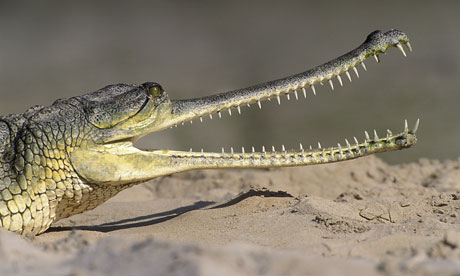
Gharials return to banks of the Chambal

Sharp-toothed crocodilians a welcome sight for local residents, especially since they only eat fish.

Gharial letter india
An Asian gharial at a crocodile farm in Pierrelatte, France. Conservation efforts on the Chambal river, in India, seem to be paying off. Photograph: AFP/Getty
We realised how lucky we were to see one of the remaining gharials in the Chambal river in Uttar Pradesh in northern India: they are now only found here and in Nepal, there being just 200 adult breeding pairs left in the wild. I could just see the characteristic tremendous bulbous knob on the end of the male gharial's long fine snout, as he glided past in the fast river.
My friend David has a real empathy for these reptiles.
"Do you know that they get gout too!" he says, amazed, as he nurses his sore foot and winces in pain, while we read a report about the mysterious deaths – seemingly from gout – of many of these reptiles. We wonder if the sick gharials also suffered from incredibly sore joints like humans experience from the disease, a form of arthritis.
Over four years ago, more than 20 gharials were found dead on the Chambal. They seemed to have been poisoned – dying from kidney failure and gout from eating contaminated fish from polluted rivers. "What a horrible death! Poor gharials," sympathises David, as we imagine the sick reptiles suffering.
But a few weeks later we hear some welcome news. The new breeding centre further up river, in the Sheopur district, is proving a success. More than 1,000 baby gharials from more than 40 mothers have hatched in the last month. On the drive back on the bus we talk to a few locals who are very excited about the gharial babies. One young boy tells me thousands have been born; a young woman tells me that there are tens of thousands.

Full Story

Friday, July 8, 2011

Volunteers try to restore Maryland's vanishing butterfly

Baltimore Checkerspots reared in captivity to offset wild declines

  • A Baltimore Checkerspot hangs on the leaf of a turtlehead plant in the Washington home of Pat Durkin.
A Baltimore Checkerspot hangs… (JERRY JACKSON, Baltimore Sun)
July 05, 2011|By Timothy B. Wheeler, The Baltimore Sun
Don't look now, but Maryland's state insect is fluttering away.
The Baltimore Checkerspot butterfly, named for the state's founding Calvert family, has dwindled to just a handful of places, mostly in Western Maryland. Experts worry that the butterfly, once fairly common, may disappear entirely from the state.
Pockets of dedicated butterfly lovers, though, are trying to slow or even reverse the decline by breeding the species in captivity. One such nursery is in a tent in back of an old maintenance shed at Black Hill Regional Park in Montgomery County.
"Here's where the larvae are," said Barbara Kreiley, pointing out tiny caterpillars clinging to the stem of a white turtlehead plant inside the tent. The crawlers are recently hatched and still green, not yet displaying their distinctive orange-and-black markings. "My little babies — see them?"
From a single caterpillar-infested plant collected from the wild last year, Kreiley, a retired nurse, and four other volunteers reared about 250 hatchlings to adulthood. About a month ago, they released them as butterflies, in spots primed to be suitable habitat for the seemingly picky creatures. Since then, patches the women recognize as butterfly eggs have been spied on the undersides of leaves at the release sites, and they have been waiting like expectant parents for them to hatch.

Meanwhile, behind the old maintenance shed, they're already working to step up production for next year, tending to nearly 20 white turtlehead plants inside the tent on which butterflies have laid eggs. Many of the plants have the beginnings of silky "tents" in their tops, spun by newly hatched caterpillars as they feed on the leaves.
Kreiley said it's "awesome, just awesome" how well the group's initial effort has gone, but acknowledges that the real test is yet to come — can the butterflies they released flourish in the wild?
On that score, the record is not encouraging. Others, including the Maryland Zoo in Baltimore, have tried captive breeding and given up after failing to see their "colonies" take hold and sustain themselves year after year. Ruth Eisenhour, a teacher at the Harford Glen Environmental Education Center in Bel Air, said she's had some success raising and releasing the butterflies in Harford County, but she's only been doing it for three years.


Full Story

Tuesday, July 5, 2011

Project MonarchHealth

Project MonarchHealth is a citizen-science survey of the occurrence of the protozoan parasite Ophryocystis elektroscirrha  (OE), which parasitizes monarch butterflies. Best known for their migrations between breeding and wintering sites throughout North America, these butterflies are also found in non-migratory populations in places such as southern Florida. This parasite is not harmful to humans; however, it can harm the butterflies by inhibiting normal growth and lowering butterfly survival in the wild.

To check for parasites, surveyors can swab the abdomen of live butterflies to collect parasite spores. MonarchHealth participants help scientists map the location and infection levels of OE in monarchs throughout the United States and determine how much disease the parasites cause.

The most essential activity is capturing and sampling wild monarchs. Either capture monarch butterflies as adults or raise the caterpillars in separate containers until they become adult butterflies. In either case, you will gently tape each butterfly’s abdomen with a sticker to collect the OE spores. Next, you will send the sample, along with a simple data sheet for each butterfly, back to the scientists at the Altizer lab where they will analyze the sample. After the data are compiled, we will send you the results of your sampling contribution as well as post them on our results page for the public to see.

Full Story

More Details